Motif · Setting
The office
The short version
Every other setting in this genre grants authority because of who the woman is. The office grants it because of what she does, and the picture can point at the evidence: the desk, the chair, the floor of the building she is on. The desk itself works as a throne with a lid, cropping the seated figure at the waist so half of her is unavailable to the viewer. The tailoring is the only costume in the vocabulary borrowed from men, and it means differently for that reason. It is also the setting that ages fastest, because it depends on the furniture and the labour arrangements of a particular decade.
This is the youngest setting in the vocabulary, and the only one that arrived from outside the tradition rather than being handed down within it. The riding field, the drawing room, the studio and the street were all in place by the middle of the twentieth century. The office turns up later, and it works on a different principle from any of them.
Everywhere else, the woman in the picture has authority because of what she is. In an office she has it because of what she holds, and the picture is allowed to show the paperwork.
Authority you can point at
The difference matters more than it sounds. Personal authority has to be asserted continuously, which is why the printed tradition needed so much apparatus: height, props, sightlines, blocking, a second figure arranged as a scale reference. Every frame has to make the case again from scratch.
Institutional authority is a fact about the world outside the picture. A desk of a certain size, a chair of a certain kind, a room on a certain floor, a door with a name on it. None of these has to be argued for, and none of them depends on the figure doing anything at all. She can be reading. She can be on the telephone. She can be turned fully away from the room, refusing the whole exchange, and the setting will hold the claim on its own.
This is why the office produces the calmest pictures in the genre. There is nothing to prove, so nothing is being performed, and the compositions can afford a stillness that the earlier material had to manufacture with poses.
The desk is a throne with a lid
Formally, the desk is a variation on the seated arrangement worked through in the throne pose, with one addition that changes everything.
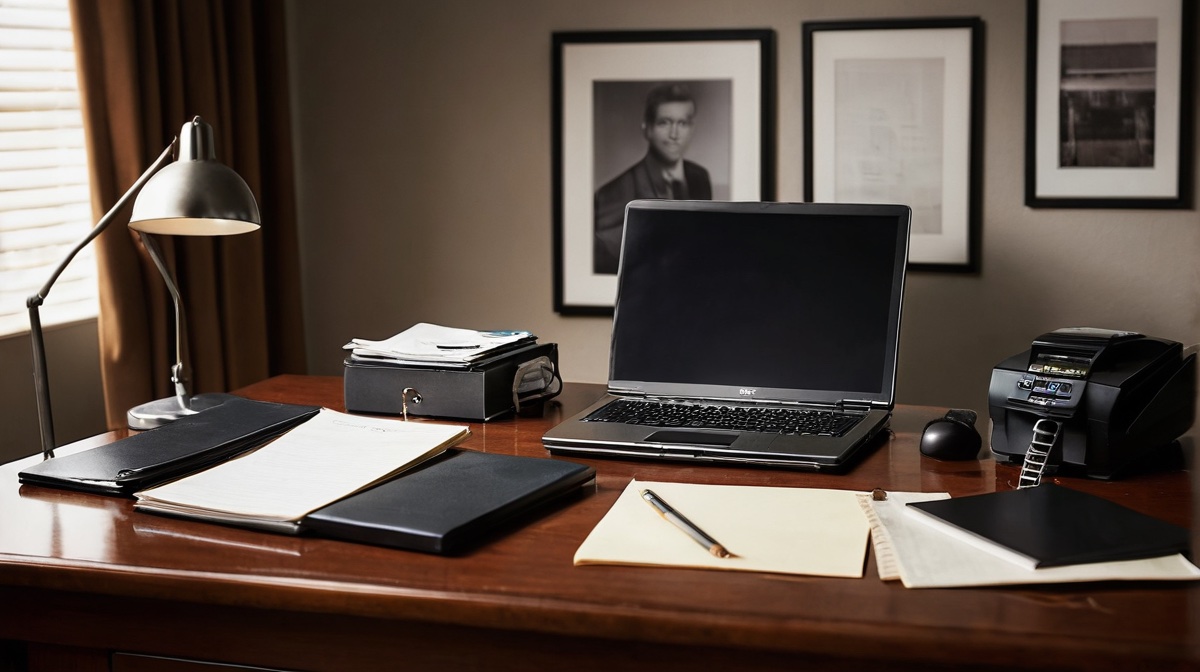
The chair does what chairs do. It raises, it licences symmetry, it brings the feet forward, it opens the floor. Then the desk is placed across the front of it, and the lower half of the figure disappears.
A body that is half unavailable is a body the viewer cannot fully read. Posture below the waist is where a great deal of unconscious signalling happens, and removing it leaves the viewer with a torso, a head and two hands, and nothing to check them against. The desk also functions as a physical barrier at exactly the distance where a standing visitor would otherwise be. He can approach to the edge and no further, and the picture does not have to explain why he stopped.
The horizontal top adds a compositional bonus. A large flat plane at chest height gives the frame a strong horizontal, somewhere to put objects that are then within her reach and outside his, and a hard edge for hands to rest on. Two hands flat on a desk is one of the very few gestures in this vocabulary that requires no prop at all.
A suit is a borrowed garment
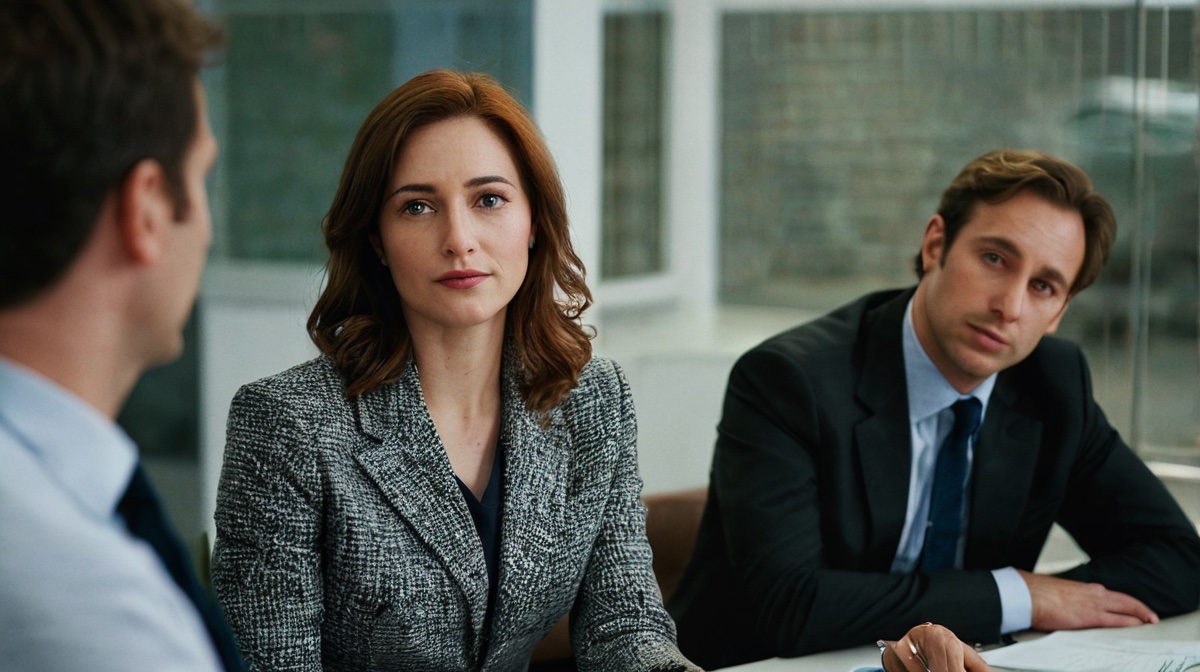
The costume question is the interesting one. Everything else the genre dresses this figure in is either historically feminine, like corsetry and evening gloves, or borrowed from a trade, like riding boots and gauntlets. Tailoring is borrowed from men, and specifically from the uniform of the people who used to hold the job.
That gives the office setting an argument the others do not have. A woman in a suit behind a desk is wearing the previous occupant’s clothes, and the picture is either aware of that or it is not. The self-aware versions play with the details: the fit exaggerated, the shoulders squared past the point of function, the tie present or conspicuously replaced. The unaware ones simply put her in a jacket and treat it as neutral, which flattens the whole thing.
The one costume element that survives from the older tradition is the shoe, and it survives because a desk cannot hide it. A seated figure behind a desk has her feet in the only part of the lower body still visible, usually at the side of the frame, catching the floor light, doing the job the boot has always done at a fraction of the earlier scale.
Height, again, but with a city under it
The genre’s oldest signal turns up here in literal form. The office is on a high floor, there is a window, and the city is below it.
This is the only setting that gets elevation without any of the usual devices. No heels, no plinth, no low camera. The figure is simply higher than everything visible in the frame, and the frame contains a large amount of world to be higher than. Photographers and production designers have leaned on it heavily since glass towers became the standard image of corporate power, and it is effective for the obvious reason that it removes the need to fake anything.
The corresponding weakness is that it flattens the figure. Backlit against a bright window she becomes a silhouette, and silhouettes are shapes rather than people. The pictures that manage it usually put her away from the glass and let the city sit in the background out of focus, which keeps the elevation and returns the face.
Why it dates faster than the others
A drawing room from 1905 still reads as a drawing room. An office from 1985 reads as 1985, immediately and unmistakably, because the furniture, the technology, the tailoring and the working arrangements all move.
That dating is not fatal, and some of the strongest examples use it deliberately, treating the period detail as the point. But it does mean the setting cannot do what the older ones do, which is float free of any particular decade. Cinema has been the main beneficiary here, because a film can commit to a year and make the specificity work for it. The interrogation-room sequence in Basic Instinct is an institutional interior of exactly this kind, and its authority comes entirely from the arrangement of the room and the procedure being followed in it.
There is one older ancestor worth naming. The insurance offices, police stations and lawyers’ rooms of the 1940s crime cycle discussed in the femme fatale in film noir are institutional settings too, and in those films the institution is always on the man’s side. The reversal is the whole of what the office setting later did with it, and the furniture barely had to change.
Questions readers ask
Why is the office a comparatively recent setting?
Because it depends on women actually holding senior positions in offices, and the imagery followed the labour market rather than leading it. The printed tradition of the mid-century had almost no use for it: a woman in an office in that material is a secretary, which is the wrong direction entirely. The setting only becomes available once a viewer can look at a woman behind a large desk and read the arrangement as ordinary rather than as a joke.
Does the suit do the same work as the leather coat?
They point at different sources of authority. A long leather coat is personal, theatrical and answerable to nobody, and it belongs to the figure alone. A tailored suit is institutional, borrowed from a male uniform, and it says that a structure has conferred something. Pictures that put both in the same frame usually end up incoherent, because the two garments are making incompatible claims about where the power came from.
Reading a sign is half of it
Every motif on this site records something two people agreed to do before anyone drew it. The drawing is the easy part.
See where it happens now