Motif · Posture
The throne pose
The short version
The throne pose works because a chair is the one object that raises a person without anyone having to explain why it is there. It also licences frontal symmetry, which is the oldest available sign of authority and comes into this genre out of state portraiture rather than out of anything erotic. The chair hands the artist a horizontal, a vertical and a diagonal at no cost, and it gives the second figure somewhere to be. What sitting takes away is reach, and the poses that survive are the ones that make that loss look deliberate.
The overview of posture on this site treats the seated figure as one term among six, worth a paragraph. It deserves more than that, because it is the only posture in the vocabulary that arrives with a thousand years of prior use attached, and because the chair underneath it is quietly the most useful object in the genre after the boot.
The counterintuitive part is well known: a seated figure usually outranks a standing one in these compositions. The reasons why are worth taking apart, because they are not all the same kind of reason.
A plinth you are allowed to have
Height is the primary signal, as the survey in who is standing sets out, and every device that produces it has a credibility problem. A dais has to be explained. A staircase requires a building. Standing on furniture reads as a stunt. Heels work but they are worn, so they belong to the figure rather than to the room.
A chair has no such difficulty. It is the most ordinary object in any interior, nobody questions its presence, and it raises a person off the floor by a fixed and generous amount. If the second figure is kneeling or seated on the ground, the difference between them is roughly the difference a plinth would give, delivered by a piece of furniture that requires no justification whatsoever.
This is also why the arrangement survives translation between media so easily. A drawing can invent any architecture it likes; a photograph has to find one. Every studio in every decade has had a chair.
Symmetry, borrowed from portraits of rulers
Nearly everything else in this picture language is asymmetrical. A hand rests on one hip, a head turns, weight shifts to one leg, a prop angles across the frame. Asymmetry is what makes a standing figure look alive.
The throne pose is the exception, and the exception is the point. A figure seated square to the camera, both feet planted, both arms on the rests, head level, produces a composition that can be folded down the middle. Symmetry of that kind is not a natural way for a body to sit. It is a formal arrangement, and viewers read it as formality before they read it as anything else.
The convention comes from outside erotic art entirely. Seated, frontal, symmetrical figures are how rulers, judges and religious authorities were depicted for centuries, and the association survived long after the political arrangements did. When the decadent illustrators of the late nineteenth century put the fatal woman in that arrangement they were making a joke that their audiences understood immediately, and by the time the postcard trade covered in from postcards to print got hold of it, the joke had hardened into a stock pose that no longer needed the reference.
What survives into the magazine era is the shape without the citation. Illustrators used it because it worked, and most of them would have been surprised to hear where it came from.
Three chairs, three different pictures
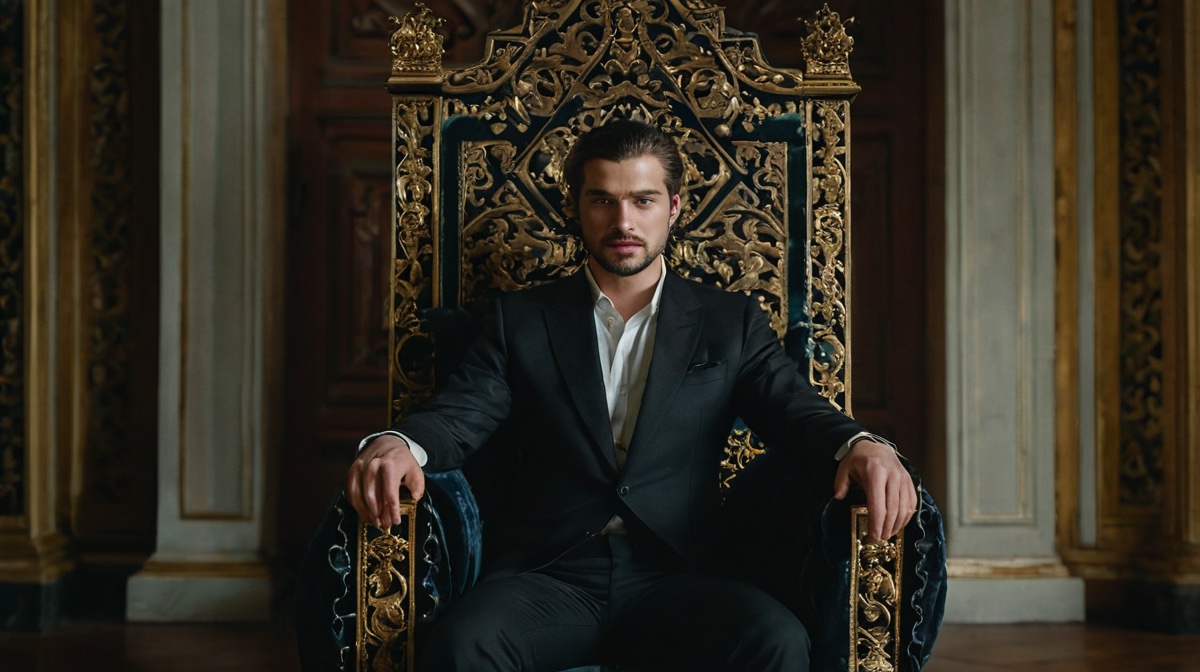
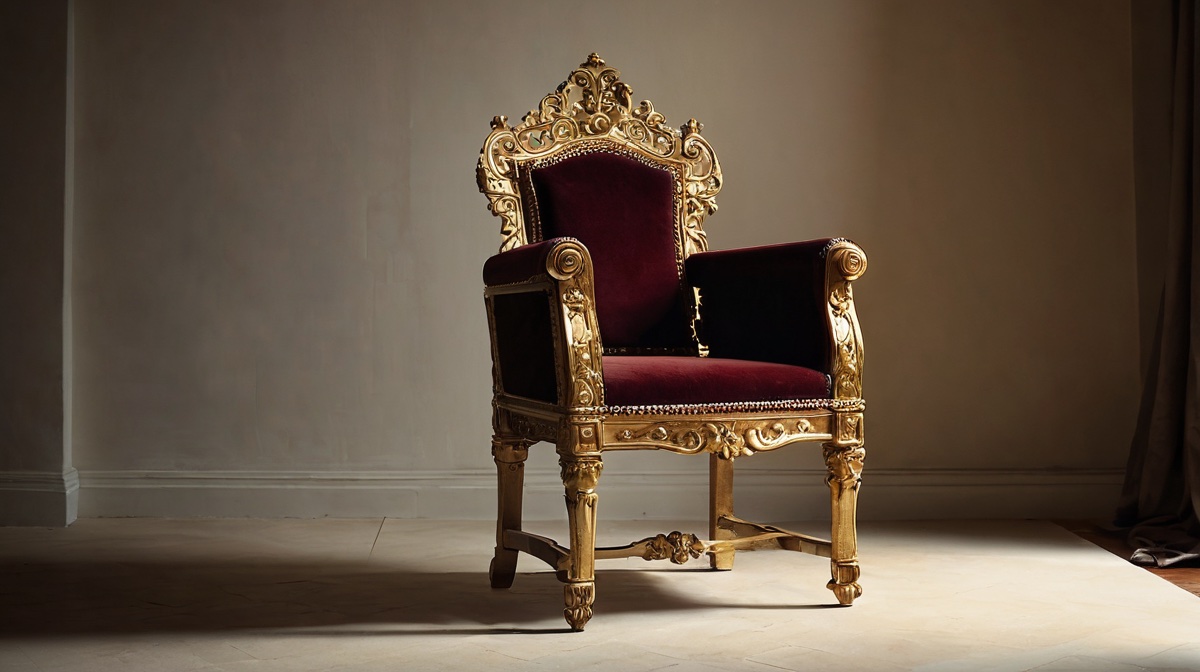
The furniture is not interchangeable, and the differences are larger than they look.
The ornate chair, high-backed and carved, is the one that most obviously says throne. It provides a decorative field behind the head, which flatters a profile and gives an illustrator somewhere to put detail. Its weakness is that it does too much: an elaborate chair can carry a weak pose, and a great many magazine plates let it.
The domestic armchair changes the register completely. It is low, soft and sideways-friendly, and it allows the pose that reads as the most secure of all: seated at an angle, one arm along the back, weight tipped away from the other figure. Formality implies an occasion, and an occasion implies that something has to be got through. Casual seating implies that the arrangement is routine. The drawing room plate on this site was built around exactly this version, and the pose survives the removal of almost all the room.
The plain hard chair is the studio option and the most demanding one. There is nothing to lean on, no decoration to absorb attention, and the figure has to hold the pose with her spine. Its reversed variant, sat astride with arms folded over the back, appears everywhere in twentieth-century photography and does something specific: it puts a barrier between the figure and the viewer while leaving the head fully exposed, which is a combination no other seated arrangement produces.
What sitting does to the feet
The unremarked consequence of the throne pose is geometric. When a figure sits, the feet come forward, toward the viewer, into the nearest plane of the picture.
That single change puts the floor in play. A standing figure’s feet are directly beneath her and are usually the least interesting part of the frame. A seated figure’s feet are the closest thing to the camera, foreshortened, catching the most light, and often crossing the lower edge. Everything the boot is capable of becomes available at close range and at the front of the composition rather than at the bottom of it.
It also creates the strongest available position for the second figure, which is on the floor at the front of the frame rather than beside the chair. The throne pose and the kneeling figure are not two separate conventions that happen to co-occur. The first produces the second, because sitting is what opens the floor.
The cost of sitting
The pose gives up reach, and the good pictures know it. A seated figure cannot cross the frame, cannot loom over the edge, cannot touch anything more than an arm’s length away, and cannot be cropped at the top of the head, which is the most aggressive thing a composition can do to a standing figure.
Weak versions of the throne pose look becalmed for exactly that reason. Strong ones convert the limitation into the argument by making it obvious that nothing needs to be reached for: everything relevant is already inside the arm’s radius, and what is outside it can wait. The most economical demonstration in the printed record is a seated figure looking at something outside the frame while the second figure, well inside her reach, is not being looked at. Nothing is happening, and the picture has said the whole thing.
Questions readers ask
Where does the throne pose actually come from?
From state portraiture, not from erotic art. Seated frontal figures on raised chairs are how European and Byzantine image-making depicted rulers, judges and saints for well over a thousand years, and the convention was still fully legible to nineteenth-century audiences. Decadent illustration borrowed it for the fatal woman, the postcard trade borrowed it from decadent illustration, and the fetish magazines inherited it fourth-hand with the meaning intact.
Does the chair have to look like a throne?
No, and the plainer versions are often stronger. An ornate chair does some of the work for the figure, which means the figure is doing less. A hard wooden chair in an empty room forces the pose itself to carry the whole claim, and when it succeeds it succeeds more completely, because nothing in the frame can be credited for it except the person sitting.
Reading a sign is half of it
Every motif on this site records something two people agreed to do before anyone drew it. The drawing is the easy part.
See where it happens now