Plate · The magazine era, 1946 to 1969
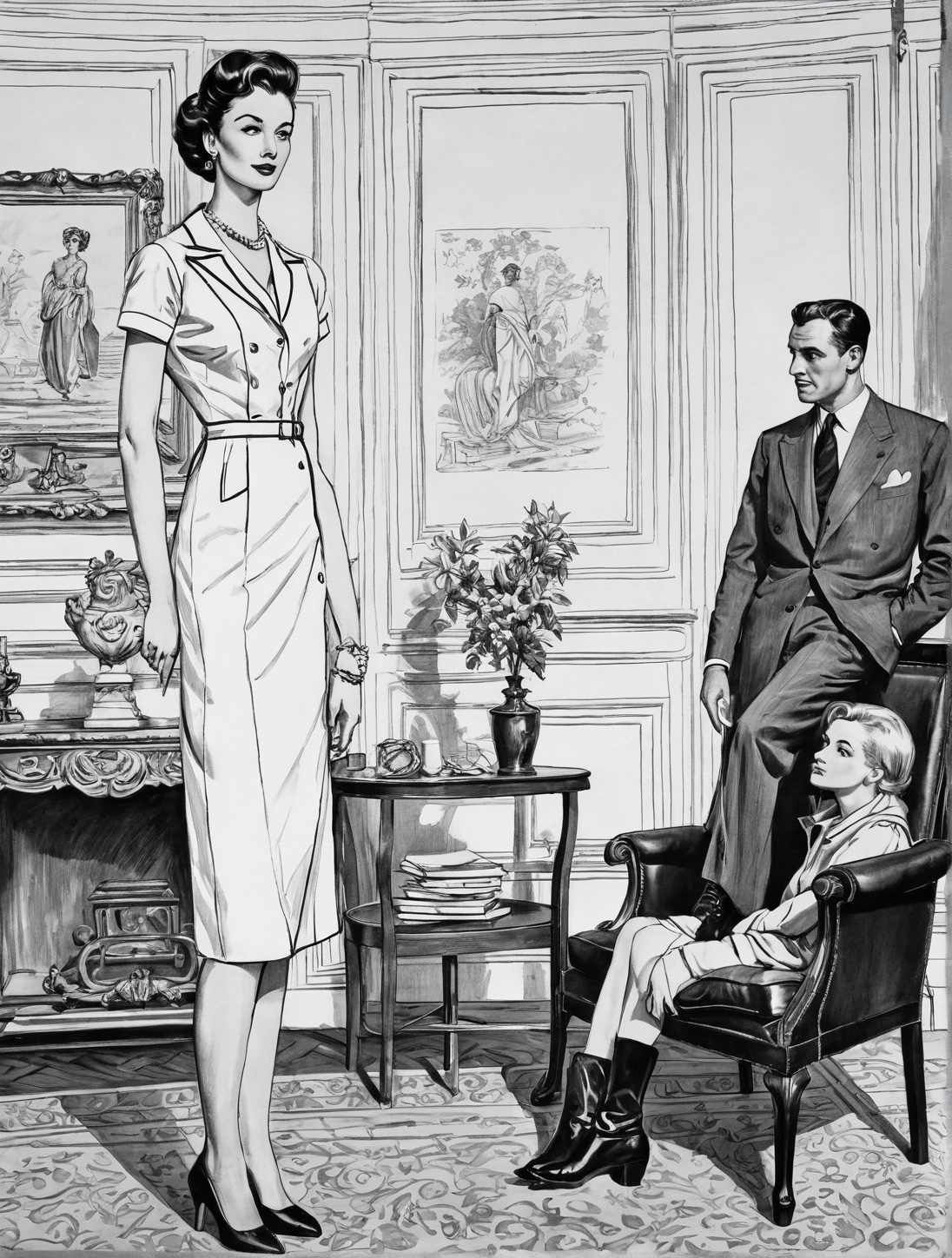
The drawing room In the manner of 1950s small-press pen and ink
A seated woman in laced boots holds the centre while the second figure is cropped to a shoulder at the lower edge.
The drawing room
This plate was made to test a claim rather than to illustrate one. The mid-century magazines habitually left their backgrounds empty, and the usual explanation is that cheap printing and short deadlines made detail impractical. Attempting the style suggests the emptiness was doing more than saving time.
The composition is built on solid black in three places: the laced boots, the high collar of the dress, and a single shadow under the chair. Everything else is line. With the room reduced to two suggested wall edges and a floor line, those three masses become the entire tonal structure of the picture, and the eye travels between them in a triangle that keeps returning to the boots.
The seated pose does the work described in who is standing. She is at rest, one arm along the chair back, and the second figure is cropped at the lower edge to a shoulder and part of a bowed head. That crop is the decisive choice. Given more of him the picture becomes a scene with two participants. Given only an edge, it becomes a portrait with a scale reference, and she is unambiguously its subject.
The pen work is deliberately coarse, with the hatching kept wide enough to survive a bad press. Drawing it that way makes the period logic obvious: the line has to be readable after it has been reduced, printed on absorbent stock and folded. Refinement was not withheld for effect. It simply would not have arrived.
The plates on this site are original works made here, produced in the manner of a period style so that the style itself can be examined. They are not historical works, they do not reproduce any existing picture, and they are attributed to no illustrator, living or dead. Where a caption says a plate is in the manner of pen and ink, of studio photography or of a hand-tinted postcard, that names the look being imitated and nothing else.
Compositions start in rooms
This plate is a copy of a way of looking, and that way of looking was learned from people who were not posing for anyone.
See where it happens now