Screen · Feature · 1992
Basic Instinct (1992): the archetype restated at full volume
- Work
- Basic Instinct
- Director
- Paul Verhoeven
- Year
- 1992
- Kind
- Feature
The short version
The Basic Instinct femme fatale is the mainstream restatement of a 1940s archetype, directed by Paul Verhoeven in 1992 from a script by Joe Eszterhas. Sharon Stone plays Catherine Tramell, a novelist under investigation, and Michael Douglas plays the San Francisco detective assigned to her. The film took the noir figure, removed the Production Code ending that had always punished her, and played the result to a very large audience. It also drew organised protests over its depiction of bisexual and lesbian characters, and a dispute about how one sequence was filmed remains unresolved between the people involved.
Basic Instinct is the version of the femme fatale that most people who have never watched a 1940s crime film are actually carrying around. Paul Verhoeven directed it in 1992 from a script by Joe Eszterhas. Sharon Stone plays Catherine Tramell, a novelist whose books resemble the killings under investigation, and Michael Douglas plays the San Francisco detective who is supposed to be investigating her. The picture was one of the largest commercial successes of its year and one of the most argued about.
Its historical function is straightforward. It took a figure that had been built inside a censorship regime and rebuilt it without one.
The archetype with the ending removed
Every element of the classic construction is present. There is a woman who may be a murderer. There is a compromised man narrating his own decline through his choices rather than his voice. There is a city shot as a maze, and there is a lineage of reference to Hitchcock, particularly the San Francisco of Vertigo, that reviewers pointed out immediately.
What is missing is the last reel that the Production Code used to require. As set out on the femme fatale in film noir, the studio-era version of this character had to be arrested, shot or otherwise stopped, and writers treated that as a tax to be paid in the final ten minutes. Verhoeven had no such obligation and declined to invent one. The film ends by withholding the answer rather than delivering judgement, and the withholding is what people remembered.
Verhoeven had already spent a decade making studio films that overplay their genre until the machinery shows, from RoboCop to Total Recall. Basic Instinct applies the same method to erotic thriller conventions. Whether the result is critique or simply the thing itself performed very loudly is a question critics have never agreed on, and Verhoeven’s own account has generally been that both can be true at once.
The interrogation room as a piece of blocking
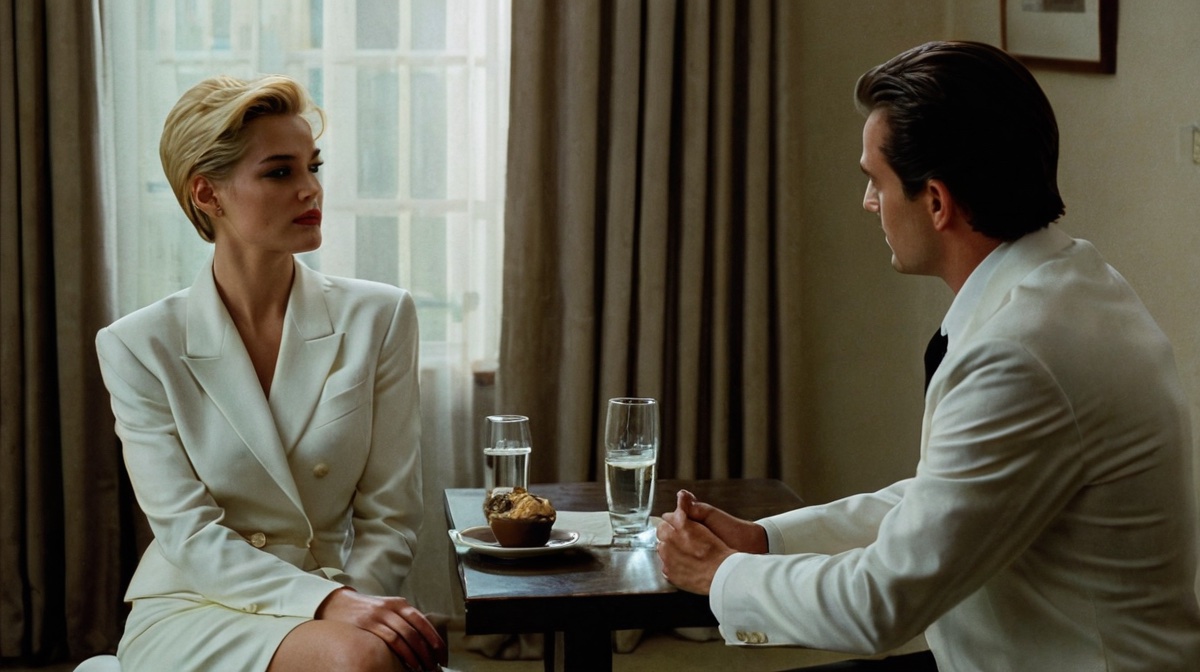
The most reproduced sequence in the film is an interview, and its staging is the reason it works as an image regardless of anything else in it. A single seated woman occupies the centre of a bare room. Standing men are arranged in a ring around her. The lighting is flat and institutional rather than the hard side light noir would use, which removes shadow as a hiding place and puts everything in plain view.
Every visual signal in that arrangement says the seated figure is the one under pressure. The scene then plays the opposite: she sets the tempo, chooses when to answer, and treats the room as hers. Inverting the meaning of a standing and seated arrangement is one of the oldest moves in this whole visual tradition, and the still-image version of it is the subject of the boot, where a single prop does the same job of relocating authority inside a composition.
A dispute about the filming of that sequence has never been resolved. Stone has said publicly that she was not told what the camera would capture. Verhoeven has publicly disputed her account. Both statements are a matter of record, they contradict each other, and this page reports the conflict without resolving it.
Protest, criticism, and what got fixed in memory
Organised protest began during production in San Francisco. GLAAD and Queer Nation objected that the script made bisexual and lesbian characters the suspects in a killing spree at a time when mainstream cinema offered very few other portrayals, so this one would be doing more work than any single film should. The protests were covered heavily and became part of the release. Defenders argued that the film’s straight characters are no better behaved and that a thriller is not a census. Both arguments were published then and both are still made.
The film also went through the American ratings process more than once, and material was removed before it secured a wide release certificate, with a longer version circulating later on home video. That sequence of events is well documented even where the details of individual cuts are not.
What survived all of it is an image. Four years later Bound took the same archetype apart and reassembled it with the alliances reversed, which reads as a direct response to a film this size. The habit of concentrating an entire argument about power into one composed frame is much older than either of them, and the plates made for this site work through the earlier versions of exactly that problem.
Questions readers ask
What did Basic Instinct change about the femme fatale?
It removed the compensating ending. Every studio-era version of this figure was required by the Production Code to be stopped in the last reel, which quietly framed the whole character as a cautionary tale. By 1992 no such requirement existed, and Verhoeven built a film whose ending withholds the resolution rather than supplying it. That is the structural difference, and it is why the film registers as a restatement rather than a revival.
Why was the film protested?
Groups including GLAAD and Queer Nation objected during the San Francisco shoot to a script in which bisexual and lesbian characters are the suspects in a series of killings, arguing that mainstream cinema had very few other depictions available at the time and that this one would therefore carry disproportionate weight. The protests were widely covered and became part of the film release. The objection and the defence were both made publicly and both are on the record.
What is the disagreement about the interrogation scene?
Sharon Stone has stated publicly that she was not told what the camera would capture during the filming of that sequence. Paul Verhoeven has publicly disputed her account. Both statements are on the record, they conflict, and no third party can settle them here. The scene is discussed on this page as staging and framing only.
The lens was pointed by somebody
A film can only record an arrangement that a group of people worked out first, usually on paper, usually in a room. That part never appears in the credits.
See where it happens now