Motif · Objects
The boot
The short version
The boot survived every change of style and medium because it solves four problems at once. It adds height, which is the main signal of authority in this genre. It supplies the darkest value in the frame, which anchors the composition. It justifies a low viewpoint without the picture having to explain itself. And its shine gives an artist a legitimate reason to draw reflected light in an image that is otherwise mostly flat black.
Every genre has a short list of objects its makers keep reaching for, and this one has an obvious leader. The boot appears in the earliest material and it is still there now, across four periods, three or four media and every shift in fashion the century managed. That kind of persistence usually means an object is doing several jobs at once, and it is.
Height is the argument
The genre’s primary claim is made through height. One figure is taller in the frame than the other, and almost everything else in the composition follows from that. A heel adds height at the point where the viewer’s eye enters the figure, which is why a picture that means to be read this way so often starts at the floor.
The addition is not only literal. A raised heel changes the whole line of the leg and shifts the weight of the standing pose backward, so the figure appears to be leaning away from the viewer even when she is not. The result is a body that reads as elevated and slightly withdrawn at once, and a pen can get both effects from a single shape. An illustrator on a deadline will take that trade every time.
The darkest thing in the frame
Most of these pictures, in every period, are built on strong tonal contrast. The mid-century magazines had no choice: cheap printing destroys subtle greys and rewards solid black. Studio photography of the following decades chose the same contrast deliberately.
In a high-contrast picture, the darkest object carries enormous weight. It stops the eye, it establishes the tonal floor against which everything else is measured, and wherever it sits becomes a corner of the composition. A black boot placed at the bottom of the frame does all of that while being entirely plausible as an item of clothing. The illustrator gets a structural anchor for free, disguised as a costume detail.
This is also why the boot so often appears at the very edge of a picture, or partly cropped by it. An anchor works best at a boundary. A composition with a dark mass at the lower corner will hold together even when the rest of it is loose.
A reason to look up
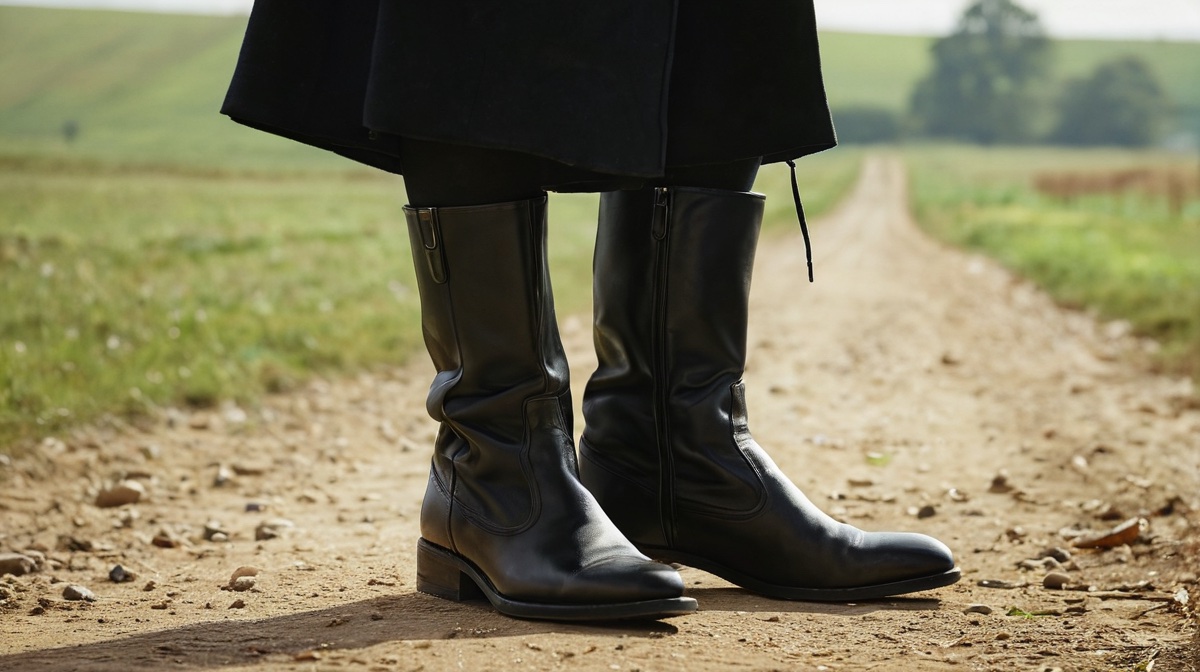
A low viewpoint is the strongest way to state a difference in status, and it is also the hardest to justify. Cameras and eyes are usually somewhere around head height, so a picture taken from knee level announces that a choice has been made, and an unmotivated choice looks like a trick.
The boot supplies the motivation. If the object of interest is at floor level, then the viewpoint at floor level is simply where the picture is looking, and the resulting distortion of the figure, longer legs, a smaller and more distant head, a face that has to tilt down to meet you, arrives as a side effect rather than a statement. Whether that is honest is a fair question. It is certainly efficient, and it accounts for a large share of the compositions in the magazines described in the magazine era.
The shine, and why an artist wants it
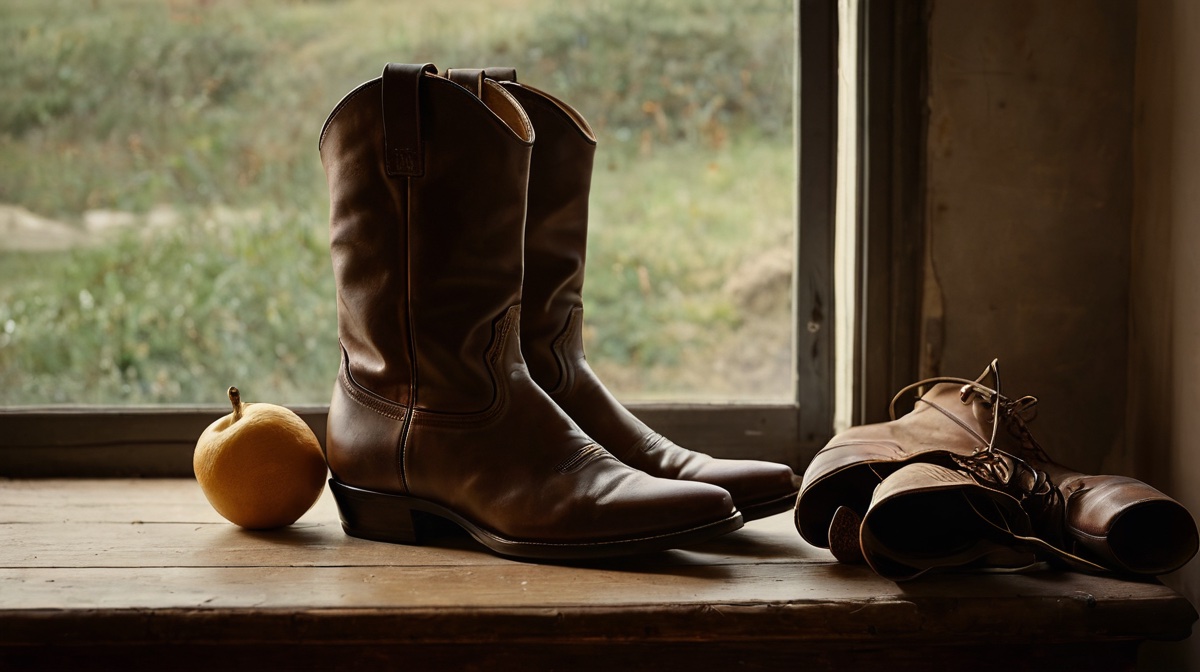
Patent leather is the other half of the appeal, and its usefulness is technical. A matte black shape is a hole in a picture. It has no interior information, and the eye slides off it. A glossy black shape is a mirror: it carries a hard white highlight, a soft reflection of whatever light is in the room, and a distorted echo of the floor and the surroundings.
That gives an illustrator something to draw inside the darkest area of the composition, which is exactly where a drawing is most likely to fall apart. It gives a photographer a very different problem, since a mirrored surface reflects the studio, the lights and sometimes the photographer, and controlling those reflections is one of the standing difficulties of the studio era. The two media inherited the same object and had to solve opposite versions of the same property.
The same boot, four decades apart
In the pre-war material the boot is usually borrowed. It belongs to riding, to the circus ring or to a stage costume, and its meaning is professional before it is anything else, as described in from postcards to print. The picture can be printed because the boot has a job.
In the mid-century magazines the borrowing stops. The boot becomes the subject, drawn with the kind of precision the correspondence pages demanded, and its construction is described more carefully than the room it stands in. By the studio decades it has turned into a lighting problem and a texture, photographed for its surface as much as its shape. In contemporary work it functions largely as a citation: it is there because the genre has always had it, and its presence tells the viewer what kind of picture they are looking at before anything else in the frame does.
The object never changed. What changed is which of its four jobs a given period needed most. One plate on this site was made in the manner of mid-century pen and ink partly to test the anchoring effect described above, and the answer is that the composition genuinely does not hold without it.
Questions readers ask
Why boots rather than shoes?
A shoe ends at the ankle and reads as a single small object. A boot is a continuous vertical shape running up the leg, so it does compositional work along the whole lower half of the figure: it lengthens, it darkens, and it gives the eye an unbroken line to travel. Height and continuity are the whole point, and a shoe supplies neither.
Does the boot mean the same thing in every period?
The object stays constant and its job changes. In the pre-war material it is usually practical, borrowed from riding and animal handling. In the mid-century magazines it becomes an end in itself and gets drawn with catalogue precision. In studio photography it turns into a light problem, since patent leather reflects the whole room. What survives across all of it is the compositional function rather than any single meaning.
Reading a sign is half of it
Every motif on this site records something two people agreed to do before anyone drew it. The drawing is the easy part.
See where it happens now