Screen · Feature · 1940s
The femme fatale in film noir: a lighting style that became a character
- Work
- The femme fatale in film noir
- Director
- Various
- Year
- 1940s
- Kind
- Feature
The short version
The femme fatale film noir archetype is a set of camera and lighting decisions before it is a character. American crime pictures of the 1940s and 1950s introduced her with a held entrance shot, lit her in hard low-key light that broke her face into light and shadow, and framed the whole story inside a male narrator recalling events in the past tense. The Production Code then required that her ending punish her. The visual grammar survived the Code, the cycle and the studio system, and it is still the fastest way a film signals that a woman is dangerous.
The femme fatale of film noir is a lighting decision before she is a person. Across a cycle of American crime pictures running from the early 1940s into the late 1950s, a working method hardened: introduce her with a held shot, cut the light hard across her face, and let a male narrator describe her in the past tense so the audience knows from the first reel that this ended badly. The dialogue is the part people quote. The lamp and the camera position did most of the work.
Critics in Paris put a name on the cycle in 1946, watching a backlog of American crime films that the war years had kept out of French cinemas. What they noticed first was the look.
Light doing the characterisation
Several of the directors and cinematographers who shaped the cycle had trained in German-speaking Europe and brought a taste for hard, directional, low-key light with them. Billy Wilder, Fritz Lang and Robert Siodmak all worked in this idiom in Hollywood, and all of them had learned their trade in a film culture that treated shadow as a structural element rather than an accident.
Low-key lighting does something specific to a face. A single hard source from the side splits it into a lit half and a dark half, and the audience reads the split as duplicity without anyone having to write the word. Add a venetian blind, a bannister or a lampshade and the shadow falls across her in bars. That figure is so worn now that it registers as parody, and it started as a cheap and effective way to tell a story about concealment in one setup.
The economics helped. Low-key lighting hides a set. A studio working to a budget can build one corner of a room properly, keep the rest in darkness, and shoot a whole sequence in it. The style people now read as expressive was, in part, a production schedule.
The entrance, and who is narrating
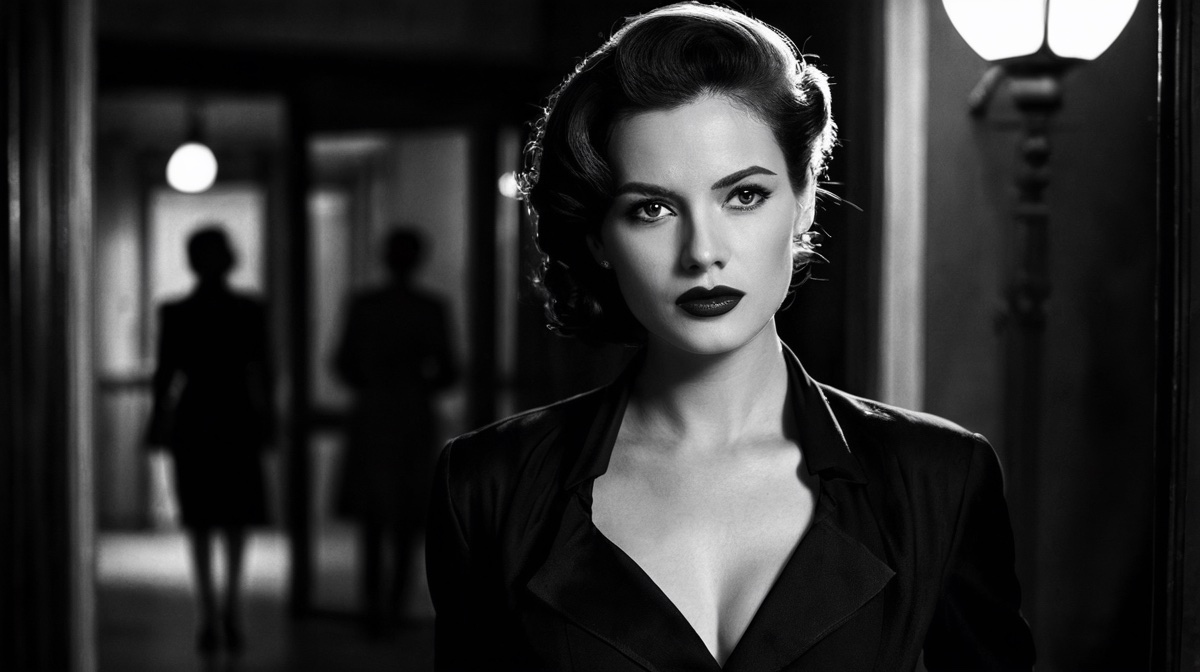
The introduction is the most stable convention in the cycle. She arrives, the film stops for her, and the camera holds. In Double Indemnity, directed by Billy Wilder in 1944, Barbara Stanwyck’s Phyllis Dietrichson first appears above the insurance salesman who has come to the house, at the top of a staircase, wrapped in a towel, looking down. The height is the whole introduction, a point the who is standing page follows across a century of still images. In Gilda, directed by Charles Vidor in 1946, Rita Hayworth is introduced by a fast tilt up as she throws her hair back into frame, and the shot became one of the most reproduced images of the decade.
Both films then do the same second thing: they hand the story to a man. Fred MacMurray’s salesman narrates Double Indemnity as a confession recorded after the fact, and Glenn Ford’s character narrates Gilda. The woman is being remembered, judged and summarised by someone who was involved. She never gets the voiceover, so she never gets to correct him. A viewer who tracks only the images in Gilda can end up with a different account of what happened than the narrator gives, and critics have made a good deal of that gap.
What the Code did to her last reel
From 1934, American studio releases passed through an office that enforced the Production Code, and one of its firmest requirements was that wrongdoing carry what the Code called compensating moral value. A character could not profit from crime, and the film could not appear to approve.
Writers solved this in the last ten minutes. She is shot, arrested, run off the road, or she confesses. The solution is so consistent across the cycle that the punishment ending stopped functioning as a moral statement and became a formality, like a copyright card. Whatever the office intended, the effect was to concentrate everything interesting about the character into the part of the film before it.
That is the core of a long argument. One side reads her as a rare studio-era woman with her own plan, briefly permitted to run it. The other reads the whole structure as a lesson about what happens to women who want things, with the punishment as the point. A British Film Institute collection of essays in the late 1970s put this dispute into circulation and it has never been resolved, partly because the films really do support both readings.
Why the grammar outlived the cycle
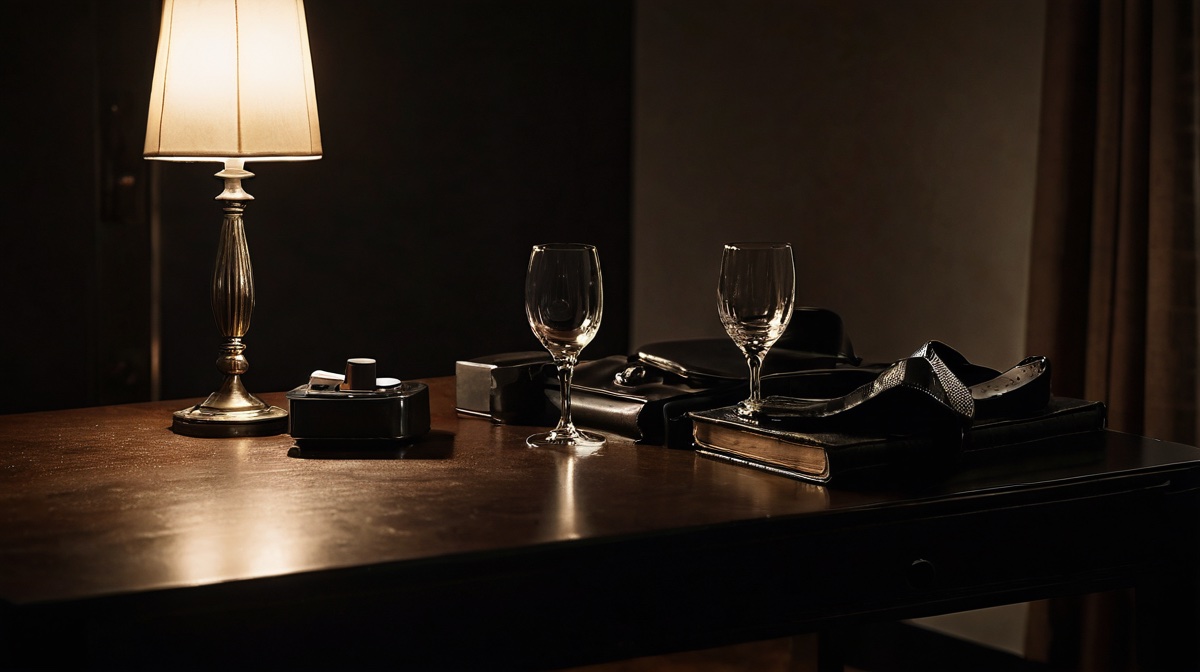
The Code was replaced by a ratings system in 1968 and the cycle had ended long before that, but the introduction shot, the hard side light and the framing of a woman as a problem to be narrated all survived intact. Every later film that wants to say dangerous in one image reaches for the same three tools, and the audience decodes them instantly.
Two later films on this site show what happens when the parts get rearranged. Basic Instinct restates the recipe at maximum volume for a mainstream 1992 audience, and Bound hands the role to a woman whose partner is the protagonist, which changes what the framing is for. The print tradition studied in the magazine era was working the same seam in the same decades with a pen instead of a lamp, and arriving at a strikingly similar shorthand.
Questions readers ask
Was the femme fatale invented by film noir?
No. The fatal woman was a standing figure in nineteenth century painting, opera and popular fiction, and the silent cinema had already marketed a version of her as the vamp, with Theda Bara sold to audiences on exactly that basis. What the 1940s crime cycle added was a repeatable technical recipe: a specific way of lighting her, a specific way of introducing her, and a narrator who tells you about her before she gets to speak for herself.
Why does she almost always lose at the end?
Because of the Production Code. From 1934 American studio films were reviewed before release by an office that required wrongdoing to carry what it called compensating moral value, which in practice meant that a character who broke the law and enjoyed it had to be arrested, killed or otherwise stopped. Writers built endings that satisfied the office. Audiences remembered the ninety minutes before the ending.
Is the femme fatale a powerful figure or a warning?
Critics have argued both for decades and the argument is not settled. One reading holds that these are among the few women in studio cinema with a plan of their own, and that the punishment ending reads as a bolt-on. The other holds that the figure exists to make female independence look lethal, and that the punishment is the point of the exercise. The films themselves support both cases, which is probably why the argument has lasted.
The lens was pointed by somebody
A film can only record an arrangement that a group of people worked out first, usually on paper, usually in a room. That part never appears in the credits.
See where it happens now