Motif · Objects
The glove
The short version
A long glove does for the arm what a boot does for the leg. It converts a jointed, awkward, hard-to-draw limb into one continuous shape, which is why the versions that matter end above the elbow rather than at the wrist. It also empties the hand of identifying detail, so a gloved hand reads as a category instead of a person. It permits touch while insulating it, which suits a genre built on withheld contact. And removing one is the only action in the whole vocabulary that has a clear beginning, middle and end.
The boot has been examined here as the object that solves four problems in the lower half of a picture. The glove is the answer to the same set of problems in the upper half, and it has been in the vocabulary just as long, with rather less written about it.
It also has one property the boot does not. A boot is worn and stays worn. A glove can be taken off in front of an audience, slowly, and that single fact has kept it in the repertoire of stage, screen and illustration for well over a century.
Bracketing the figure
Put a long glove and a tall boot in the same picture and the figure is capped at both ends by the same dark or the same pale value. The eye reads the two as a pair, and everything between them, whatever the dress happens to be doing, becomes a middle section held between two firm terminals.
That bracketing is why the arrangement survived so many changes of fashion. The dress could be a riding habit, a corseted gown, a leather coat or almost nothing, and the composition still held, because the structural work was being done at the extremities. Illustrators working to a monthly deadline could change everything in the middle of the figure and leave the two anchors alone, which is roughly what the mid-century magazines did for twenty years. The same anchoring logic, seen from the floor up, is the subject of the boot.
There is a secondary effect on proportion. Both objects extend a limb visually beyond where it actually ends, so the figure reads as longer than it is drawn. Two lengthened limbs on one body produce a figure that seems to have been stretched, and the exaggerated proportions people associate with this material are often the props rather than the anatomy.
A hand with no history
Bare hands carry a great deal of information nobody asked for. Knuckles, tendons, nail shape, rings, the particular way a person’s fingers rest. All of it reads as biography, and biography makes a figure specific.
A glove deletes every bit of that. What remains is a shape: five tapered forms and a palm, in one uninterrupted value. The hand stops being anyone’s hand and becomes a generic instrument, which is precisely what an image trading in types rather than portraits needs. In the mail-order material this mattered commercially as well, since a reader ordering by post from a small catalogue was buying an idea rather than a person, and specificity was a liability.
For the illustrator there is the same practical bonus that any held prop provides. Hands are the part of the figure most likely to give a drawing away, and a gloved hand can be built from three or four confident strokes. The magazine-era pages are full of figures whose faces are carefully modelled and whose hands are two dark mittens, and nobody complained, because the glove made it a stylistic choice rather than a failure.
Contact without contact
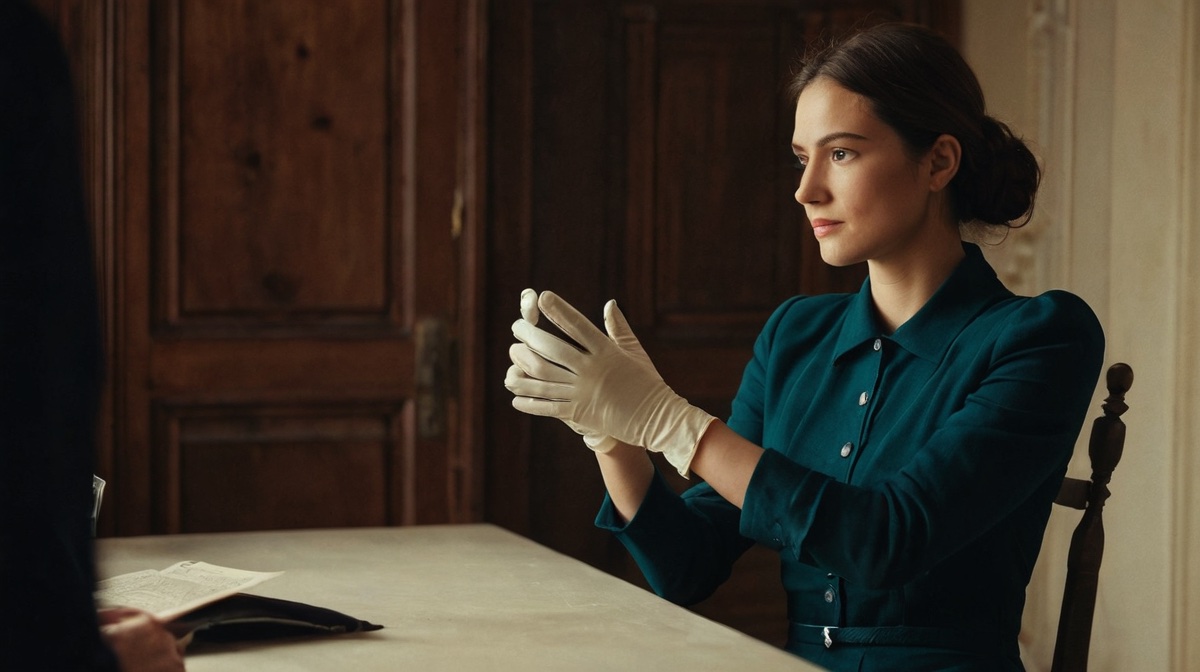
The larger part of this vocabulary is about withheld touch. Figures are near each other and not touching; a look passes over a head rather than at it; an object connects two people across a gap without either of them moving. Actual physical contact is comparatively rare in the printed material, and when it happens it tends to be brief and instrumental.
The glove is the object that manages this. It permits a hand to be placed on a shoulder, a chin, a collar, while keeping a layer between the two people, and the layer is visible in the picture. The gesture happens and the insulation is on display, so the image gets the composition benefit of contact without giving up the distance the whole arrangement depends on.
That reading holds across media. In photography the same effect appears as a highlight: a gloved hand resting on bare skin produces a hard tonal edge exactly where the contact is, and the eye goes straight to it. Contact that would be nearly invisible bare becomes the brightest event in the frame.
Two different gloves
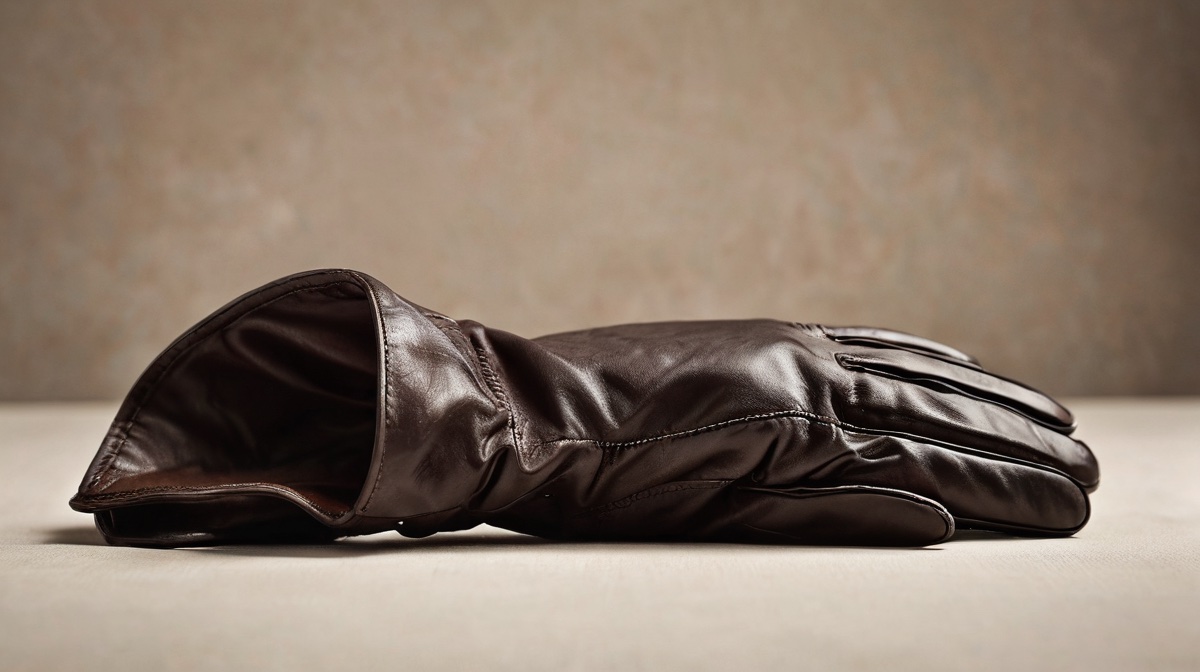
Two separate garments get called the same thing and they are not doing the same job.
The evening glove, in kid or satin, comes from formal dress. It belongs to the opera house, the ballroom and the drawing room, and it brings all of that with it. Decadent illustration and the postcard trade described in from postcards to print used it constantly, because it let a picture claim rank without needing a room to prove it. A woman in above-elbow evening gloves has been placed in a social position before anything else in the composition has spoken.
The gauntlet, in heavy leather, comes from riding, driving, falconry and work. It flares at the cuff, which changes the silhouette completely: instead of a smooth taper, the arm ends in a hard shape wider than the forearm. That flare reads as equipment, and it pushes the figure toward competence rather than status. Mid-century illustration moved between the two registers freely, and the choice is usually a reliable indication of what a particular publisher thought its readers wanted.
The one action the vocabulary allows
Almost nothing in this picture language has a beginning and an end. A pose is a state. A prop is at rest. A gaze is held. Removing a glove is the exception, and it is the reason the object outlived its own fashion cycle.
It takes time, it is visible from a distance, it has a sequence, and it can be stopped at any point. Stage performance worked this out long before cinema did, and cinema then made the most reproduced version of it. In Gilda, directed by Charles Vidor in 1946, Rita Hayworth performs a number in which the removal of a single long glove functions as an entire routine, and the sequence has been reproduced, imitated and parodied continuously since. The film is discussed here as part of the wider grammar in the femme fatale in film noir.
What the still image inherited from that is not the striptease but the pause inside it: one glove on, one glove half off, the second hand still working at the fingers. It is the only moment this vocabulary offers where something is genuinely unresolved, and illustrators returned to it for decades because a picture that has not finished happening is much harder to put down.
Questions readers ask
Why does the length matter so much?
Because the elbow is the problem. A wrist-length glove leaves the forearm, the elbow and the upper arm as three separate passages of drawing, each needing its own modelling. A glove that runs above the elbow covers all three and delivers a single tapered form from fingertip to shoulder. That is one shape instead of three, it holds together at small reproduction sizes, and it gives the arm the same visual continuity a boot gives the leg.
Is a leather glove read differently from a satin one?
Yes, and the difference is one of borrowed context rather than anything intrinsic. Kid and satin evening gloves come out of formal dress and carry the drawing room with them, so they read as rank. Leather gauntlets come out of riding, driving and manual work, so they read as capability. Periods swap between the two depending on which claim the material was making, and a picture that uses both at once is usually confused about what it wants.
Reading a sign is half of it
Every motif on this site records something two people agreed to do before anyone drew it. The drawing is the easy part.
See where it happens now