Screen · Feature · 2013
Venus in Fur (2013): one room, two actors, and a reversal
- Work
- Venus in Fur
- Director
- Roman Polanski
- Year
- 2013
- Kind
- Feature
The short version
The Venus in Fur film, directed by Roman Polanski in 2013, is a French-language two-hander adapted from David Ives play of the same name, which in turn draws on Leopold von Sacher-Masoch 1870 novella Venus in Furs. Emmanuelle Seigner plays an actress auditioning for a stage version of the novella and Mathieu Amalric plays the writer and director running the audition. The whole film takes place in one empty theatre. Confining it to a single set turns the reversal of authority between the two characters into the only event on screen, which is precisely the point.
Venus in Fur is a film about an audition that stops being an audition. Roman Polanski directed it in 2013, in French, from David Ives play of the same title, and it runs its entire length inside one empty theatre with two performers. Emmanuelle Seigner plays Vanda, an actress who arrives late for a casting call. Mathieu Amalric plays Thomas, the writer and director who has spent the day seeing candidates and has given up on the part. She persuades him to read the male role opposite her, and the reading does not end where he expects.
The compression is the method. Take away every location, every subplot and every third character, and what is left is the only thing the film is interested in: which of these two people is running the room, and how often that changes.
A novella, a play, a film
The lineage gets muddled in summaries, so here it is in order. Leopold von Sacher-Masoch published Venus in Furs in 1870, a novella in which a man named Severin persuades a woman named Wanda to take command of him and puts the arrangement in writing. The psychiatrist Richard von Krafft-Ebing later took Sacher-Masoch’s surname to label a clinical category, which is how a nineteenth century Galician novelist ended up as a common noun.
David Ives wrote his play Venus in Fur well over a century later, staging the novella as a modern audition in which an actress and a director read scenes from an adaptation of it. Nina Arianda, who originated the part in New York, won a Tony Award for it. Polanski’s film keeps that structure and moves it to Paris. So the film is an adaptation of a play about an adaptation of a novella, and every layer is about somebody trying to control a text that keeps getting away from them.
The reversal as a piece of theatre craft
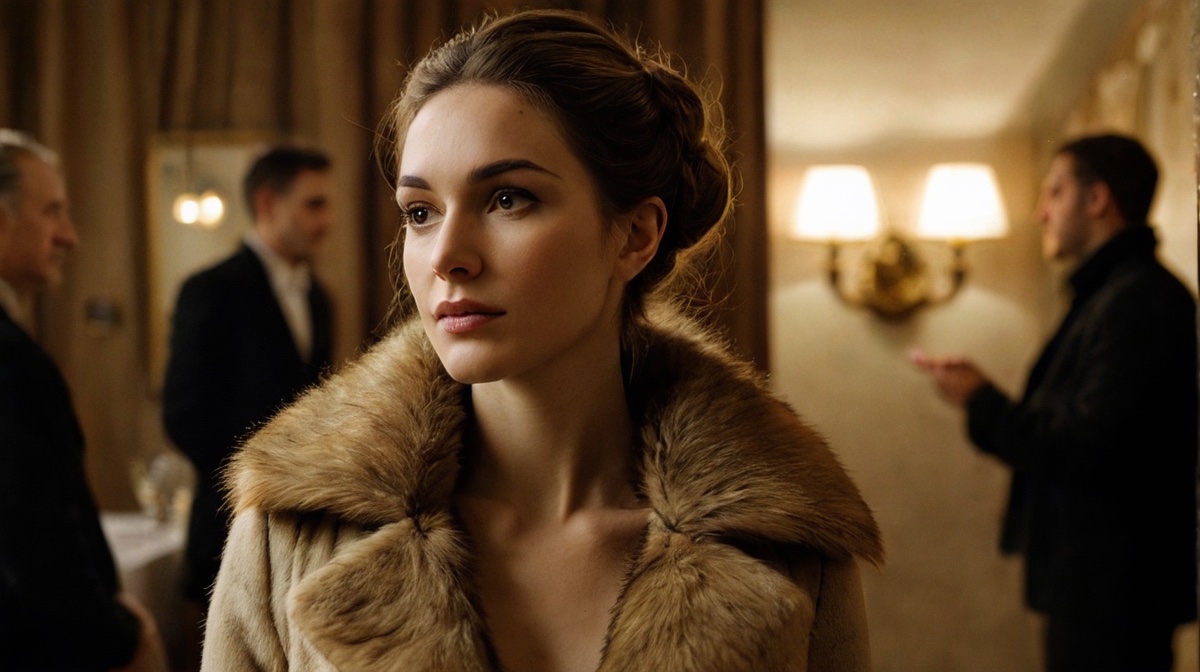
The device Ives found is a good one. Vanda has come to be judged. Thomas holds the script, the schedule and the decision. Then he agrees to read with her, and the moment he takes a part, the authority in the room starts to move, because a director who is performing is no longer only directing.
Everything after that runs on very small adjustments. Who is holding the pages. Who suggests a note and who accepts one. Who is standing when the other is sitting, which the who is standing page tracks as the oldest signal in this whole visual tradition. A film that changes location can carry a shift like this by putting the characters somewhere else. This one has nowhere else, so the shifts have to be played, and both performers are up to it.
Seigner and Amalric had each worked with Polanski before, and the confidence shows in the pacing. Critics also noted, more or less unanimously, that Amalric bears a strong physical resemblance to the director, which adds a further layer to a film about a man losing control of his own adaptation.
What the novella supplied and what film adds
Sacher-Masoch’s book gave later picture-makers a small kit of props that has never gone out of use: the fur, the raised heel, the contract, the woman positioned above. Those items travelled out of literature into the postcard trade and then into the mid-century magazines, a route described in from postcards to print and visible in the working style of illustrators like Eric Stanton, who drew that same figure hundreds of times without necessarily knowing where she came from.
The film’s contribution is duration and proximity. A drawing shows the arrangement at one instant, at the moment of maximum clarity. A camera can sit on a face for two minutes while somebody works out what they have agreed to, and Venus in Fur is largely made of that. It is also, unlike almost every entry in the femme fatale in film noir, a film in which nobody has to be punished for the ending to arrive.
The signature on the film

Polanski’s legal history in the United States is a matter of public record. He pleaded guilty in 1977 to a charge arising from a case involving a minor, left the country before sentencing, and has not returned. For many viewers and critics that record is decisive and it governs how they treat the work; for others the film is assessed separately. Both positions are held seriously and this page does not adjudicate between them. Readers weighing whether to watch it should know the record exists rather than encounter it later.
Questions readers ask
Do I need to have read Sacher-Masoch to follow the film?
No. The characters explain the novella to each other as part of the audition, because the actress has read it and the director assumes she has not. That gives the film a natural way to summarise its source without a narrator. Knowing the novella adds a layer, since the film keeps quoting situations from it while inverting who controls them, but the drama works without it.
Is this a faithful adaptation of the play?
Close, with the obvious relocations. Ives set his play in a New York rehearsal room and wrote it in English; the film moves it to a Paris theatre and plays it in French. The two-hander structure, the single set and the audition framing all survive. What changes is what a camera can add: a lens can move nearer to a face than a theatre seat ever gets, and the film uses that.
Why does the single location matter so much?
Because it removes every other source of change. In a film with locations, a shift in the balance between two people can be carried by moving them somewhere new. Here nothing moves except the two of them, so every adjustment in who is directing whom has to be visible in blocking, in who is standing, and in who is holding the script. The constraint concentrates the subject rather than limiting it.
The lens was pointed by somebody
A film can only record an arrangement that a group of people worked out first, usually on paper, usually in a room. That part never appears in the credits.
See where it happens now