Screen · Feature · 1976
Maîtresse (1976): the film that treated the work as work
- Work
- Maîtresse
- Director
- Barbet Schroeder
- Year
- 1976
- Kind
- Feature
The short version
The Maîtresse film, directed by Barbet Schroeder and released in 1976, was the first widely distributed European feature to place a professional dominatrix at the centre of a drama and treat her occupation as an occupation rather than a punchline or a symptom. Bulle Ogier plays Ariane and Gérard Depardieu plays the man who becomes involved with her. Schroeder came to it from documentary and the film carries that habit of observation. Its content was contested from the start, and censors in several territories restricted or refused it for years.
Maîtresse, directed by Barbet Schroeder and released in 1976, is the film that stopped treating a professional dominatrix as a symptom. Bulle Ogier plays Ariane, who works at this for a living. Gérard Depardieu plays Olivier, a young man who falls into her orbit and cannot decide what he thinks. The picture is a French drama with a documentary temperament, and its main formal decision is to look at the work steadily rather than to shudder at it.
That decision is why the film still gets cited. It is also why it spent years in front of censors.
A documentary habit brought into fiction
Two years before Maîtresse, Schroeder had released a feature documentary portrait of Idi Amin, made by pointing a camera at his subject and letting him talk. The habits of that job carry straight into the fiction that follows. Equipment is shown as equipment. Procedure is shown as procedure. There is very little of the heightened lighting a thriller would apply to the same material, and almost none of the moralising cutaway that a mainstream film of the period would have used to reassure an audience.
The result is a register that was unusual in 1976 and is still not common. When a film treats an unfamiliar occupation the way it would treat a dentist’s surgery, the audience is left to supply its own reaction, and a lot of the discomfort the picture generated came from that refusal to supply one. Costume did serious work here too: Karl Lagerfeld, then designing at Chloé, produced the clothes, which put couture rather than costume-shop leather on screen and quietly insisted that this was a professional presenting herself.
Two people trying to agree on what is happening
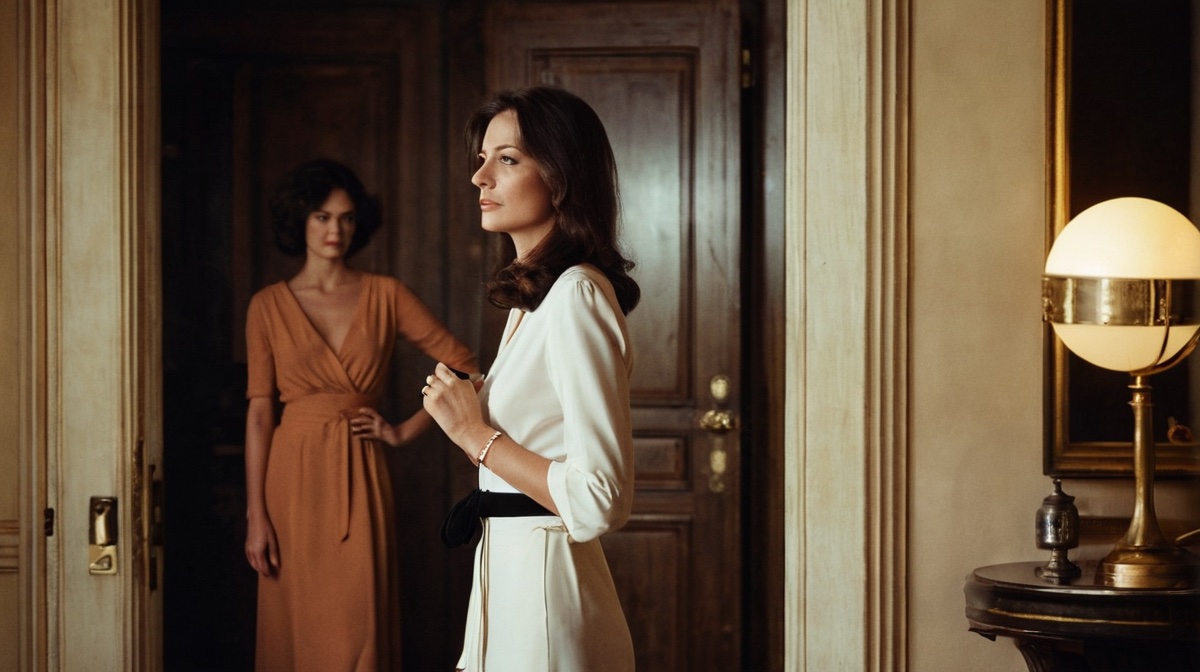
Underneath the milieu, the film is a two-hander about negotiation. Ariane has a practice, a routine and a clear sense of the boundary between her work and the rest of her life. Olivier arrives without any of that and spends the film testing where the lines are, sometimes clumsily. The drama is not whether he will be shocked. It is whether the two of them can agree on the terms of anything at all.
Ogier was an established figure in French art cinema by then, having worked with Jacques Rivette and Luis Buñuel, and she plays Ariane with a flat competence that gives the part its authority. Depardieu, only a couple of years past his breakthrough, plays the man as unfinished, which is the correct choice. Placing the more experienced performer on the side of the woman with the profession tilts the film before a word is spoken.
Height and posture do less of the signalling here than they do in the printed tradition covered by the magazine era, where a raised heel and a low viewpoint carried the entire argument in a single frame. A film has ninety minutes and can afford to let authority show up as calm rather than as scale, which is the more interesting version and the harder one to draw.
The censorship record
Maîtresse was contested on release and stayed contested. The British case is the best documented: classifiers refused it a certificate when it was first submitted, and it reached cinemas there years afterwards in an altered form. Other territories restricted it in various ways. Reports differ on precisely what was removed and precisely when, which is why this page states the shape of the record and leaves the itemised version to archives that hold the paperwork.
Two separate objections were in play and they are often collapsed into one. The first was about sexual content and what a certificate could permit. The second was about material in the film unrelated to that, which drew complaints of its own. Reading the censorship history as a single argument about sex misses half of what was actually being disputed.
What the film left behind
Maîtresse did not create a genre. What it did was establish that this subject could carry a serious feature with real actors and a real budget, and that a director could point a camera at it without either sniggering or panicking. Later films that put a dominant woman at the centre are working in space this one cleared, whether or not they acknowledge it.
The clearest measure of its distance from what came before is the archetype page on the femme fatale in film noir, where a woman with power over a man is by definition a problem the plot must solve. Ariane is not a problem to be solved. She is a person with an appointment book, and the film’s radicalism is almost entirely contained in that difference. Who was holding the camera matters here as well, a question taken up in women directing and shooting the genre.
Questions readers ask
Why is Maîtresse considered a landmark rather than just a provocation?
Because of where it puts the camera. Earlier films that touched this territory framed a dominant woman as a symptom, a joke or a threat to be resolved. Schroeder frames her as a person with a trade, a diary and overheads, and lets the drama come from the man trying to work out what he thinks about it. That shift in emphasis, from spectacle to occupation, is what later writers point back to.
Was the film actually banned?
It ran into classification trouble in several countries and its British release history is the most documented case: classifiers there refused it a certificate on first submission and it reached British cinemas only years later, in an altered version. Accounts of what was cut and when vary between sources, so this site states the shape of the record rather than a definitive list.
How close is the film to the real Paris milieu of the period?
Schroeder has said in interviews that the production researched the actual milieu and drew on people from it. That is his account and it is the one usually repeated. What can be judged from the film itself is the register: costume, equipment and procedure are shown with the flat curiosity of a documentary rather than the heightened lighting a thriller would use.
The lens was pointed by somebody
A film can only record an arrangement that a group of people worked out first, usually on paper, usually in a room. That part never appears in the credits.
See where it happens now