Screen · Documentary · 1996
Fetishes (1996): the film about a man holding a microphone
- Work
- Fetishes
- Director
- Nick Broomfield
- Year
- 1996
- Kind
- Documentary
The short version
Fetishes, directed by Nick Broomfield in 1996 for HBO, was filmed over roughly two months inside a Manhattan house of domination founded and run by a woman working as Mistress Raven. Broomfield works in the open, on camera, carrying his own sound, and the film is organised into eight named chapters like a trade catalogue. Its most discussed sequence is one in which the women working there try to draw him into a session and he retreats behind his boom microphone. Critics were divided, and the sharpest objection was that a director whose method depends on participation never found a way to participate here.
Fetishes, directed by Nick Broomfield in 1996 and made for HBO, was shot inside Pandora’s Box, a house of domination in Manhattan founded and run by a woman working as Mistress Raven. The crew was there for roughly two months. What came back is a film in which the professional practice is filmed steadily and at length, and in which the most memorable passages are about the person filming it.
That is worth taking seriously rather than treating as a failure. This site is largely about pictures made by people who never appear in them. Here the maker is in the frame the whole time, and the result is an unusually clear record of what it costs to point a camera at this subject.
A method that usually works
Broomfield’s approach by this point was well established and easy to describe. He travels light, works with a cameraman, handles his own sound, and makes no effort to hide the microphone or the camera. He appears on screen, asks the questions himself, and leaves in the negotiations, the refusals and the moments when a subject decides how much to give him.
Applied to institutions that would rather not be filmed, that method has a purpose. The apparatus becomes visible, the viewer sees the conditions under which the material was obtained, and the film declines to pretend it is a neutral record.
Pandora’s Box is a different kind of subject. It is a business whose whole practice consists of arranging rooms, controlling attention and deciding what a visitor is permitted to see. A director who walks in and makes himself part of the scene has not introduced a complication. He has arrived somewhere that already knows how to handle a man who wants to look.
Eight chapters, arranged like a catalogue
The film is organised into eight named sections: slaves, mistresses, rubber, wrestling, corporal punishment, masochism, infantilism, and what it calls socio-political fetishes. Each heading introduces a category, examples follow, and the film moves on.
The structure is worth pausing on because it is not a documentary shape at all. It is the shape of a mail-order catalogue, which is exactly how the printed material described in the magazine era organised the same subject forty years earlier. Categories, headings, examples under each, a reader working through the list to find their own entry. Broomfield almost certainly arrived at it for editing reasons rather than as a reference, and it has the same effect as the original: it makes the whole thing legible and slightly inert, a taxonomy rather than an account.
What the chapters buy is range. The film gets through more of the trade than a narrative treatment would, and the clientele is placed clearly, largely lawyers, bankers and brokers paying substantial fees for sessions. The cost is that nothing accumulates. Each section starts again.
The boom microphone
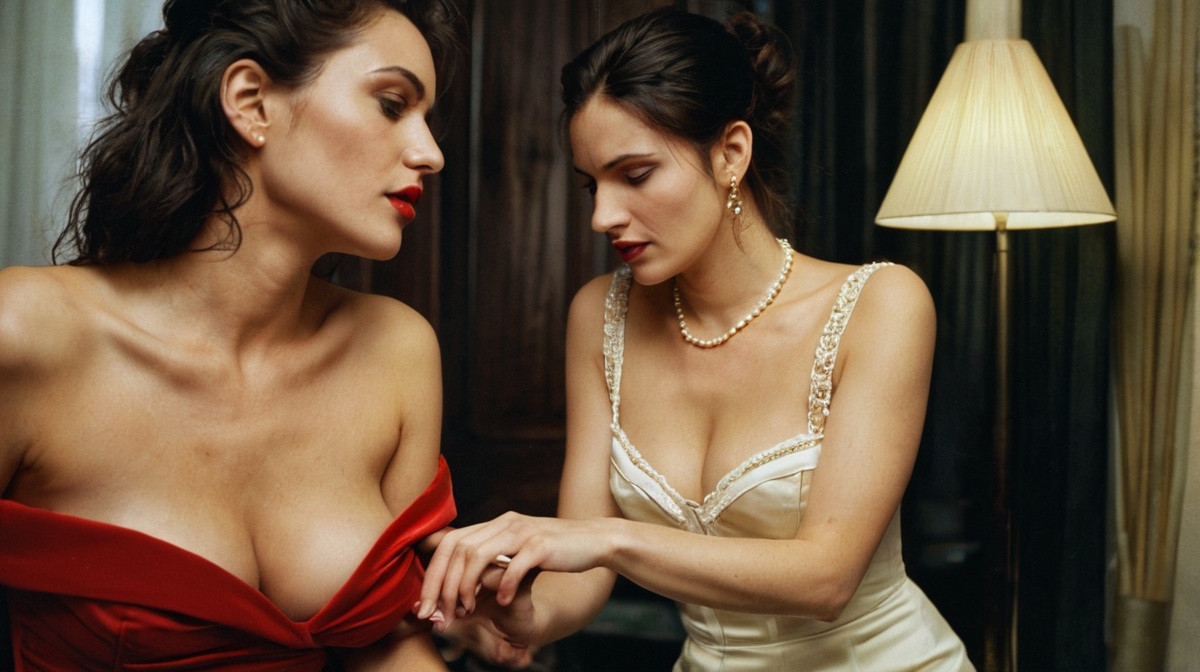
The sequence everybody cites comes when the women working in the house turn the camera around and invite Broomfield to be a client rather than a documentarian. He declines, on the grounds that he does not like pain, and ends up backed against a wall holding his boom microphone out in front of him.
It is funny, and it is also the most precise thing in the film. The equipment that was supposed to make him an observer becomes the only thing keeping him from being a participant, and he uses it as a barrier in exactly the way a piece of furniture gets used in the still images this site studies. The apparatus stops being invisible and starts being a prop in somebody else’s scene.
The same reversal turns up in the printed tradition whenever a reflective surface catches the person operating the camera, a problem examined in the mirror. A picture that shows its own making has to survive the presence of the maker, and most of this material cannot. Broomfield leaves it in, which is to his credit whatever else the sequence does to his authority.
What the film will not do
The strongest critical objection, made in several reviews at the time, is that Broomfield gets extraordinary access and then declines to use it. He is inside the building, on first-name terms, filming sessions, and he never crosses into the practice itself, even to the limited extent that would let him report what it is like from within.
Whether that is a failure of nerve or an entirely defensible professional boundary is a fair argument, and the reviews divide roughly along that line. Roger Ebert rated it well and found it genuinely mixed in tone. Others found it thin, and the aggregate critical figure for the film is low by his standards, with the recurring complaint being that his persona had become a routine.
The comparison that clarifies it is Maîtresse, which is fiction and does the opposite. Barbet Schroeder’s film has no director in it, no visible apparatus and no reflexivity at all, and it gets closer to the texture of the work because it simply looks at it. A documentary with the man in the frame turned out to be further from the subject than a drama that stayed out of the way.
Why it still matters
For all of that, the film records something the printed century could only invent. Every image on this site from the pre-war postcards to the magazine plates is a picture of an arrangement that a publisher imagined, an illustrator drew and a reader paid for. None of it is a record of a working establishment.
Fetishes is. The rooms are real rooms, the equipment is in the state that real equipment is in, and the women are running a business with overheads and a bookings diary. Whatever the film fails to do with that, it is one of the very few filmed accounts of the professional space from the period, and the difference between it and the drawn version is instructive in both directions.
It also puts the authorship question on screen, which is where this site tends to end up. Who was holding the camera, what they were allowed to see and what they did with it are the standing questions of the whole tradition, and this film answers all three about itself, in the open, for eighty minutes.
Questions readers ask
Is Fetishes a reliable record of the place it filmed?
It is a reliable record of what a camera crew was shown over about two months, which is a narrower thing. The proprietor conducts the tour, chooses the rooms, and introduces the staff, so the film inherits her account of her own business. That is not a criticism of the film so much as a description of what documentary access actually buys, and Broomfield leaves enough of the negotiation on screen for a viewer to see it happening.
Why do critics rate it below his other films?
Because the method he is known for depends on his presence generating friction, and here the subject absorbs it. A house of domination is already a place organised around who directs a room and who is being watched, so a director who inserts himself is not disrupting anything, he is joining a structure that was already running. Several reviewers made a version of this point, and the aggregate scores for the film sit well below those for his better-known work.
The lens was pointed by somebody
A film can only record an arrangement that a group of people worked out first, usually on paper, usually in a room. That part never appears in the credits.
See where it happens now