Motif · Gaze
The mirror
The short version
A mirror is the only object in these pictures that has an opinion. It puts two versions of the same figure in one frame and lets them do different things, which no other device can manage. It solves the central problem of the turned back by returning a face without turning the body. It carries a moralised history from European painting that this genre inherited and quietly stripped out. And it can catch the person holding the camera, which turns a picture about a woman into a picture about who is making it.
A room in this genre is usually close to empty. When something is allowed into it, the object is normally passive: a chair to sit on, a table to rest a hand on, a door for somebody to stand in. A mirror is the exception, because it is the only thing in the frame that does something on its own.
It also doubles the subject, which is a considerable event in a composition built around a single figure and a strict hierarchy of attention.
Two of her, doing different things
The obvious property is duplication, and the useful property is that the two versions need not agree.
A figure can face the room while her reflection faces the viewer. She can be looking down while the reflection appears to be looking out. One can be in light and the other in shadow, one sharp and one soft, one whole and one cropped by the frame of the glass. The picture gets two statements from one person, and the tension between them is unavailable by any other means.
That second version also solves a practical difficulty. A single figure in an empty room is a small amount of information, and illustrators of the mail-order decades were forever short of things to put in a frame that would not cost drawing time. A mirror gives you a second figure, a second light effect and a suggestion of a larger room, all from geometry that can be approximated rather than observed.
The face a turned back cannot give you
The most valuable thing a mirror does is resolve the trade described in the turned back. Turning a figure away is the strongest refusal in the vocabulary and it costs the picture its face, which is a real loss. The over-the-shoulder glance recovers the face and gives up most of the refusal.
A mirror gets both. The body stays fully turned, the back does its work as a surface and an obstruction, and the face arrives separately, at a distance, in a frame of its own. The viewer is refused by the person and granted access by the glass, which is a stranger position to be in than either state alone.
European painting arrived at this centuries ago. The best-known instance is Velázquez’s Rokeby Venus, painted around 1647 to 1651 and now in the National Gallery in London, in which a figure seen entirely from behind is given a face by a mirror that Cupid holds up in front of her. The reflection is famously wrong, both in what it could physically show and in how indistinctly it is painted, and the imprecision has been argued about ever since.
The picture also has a history of being looked at. The suffragette Mary Richardson attacked it with a meat cleaver in the National Gallery on 10 March 1914, and the reason she gave at the time was the government’s treatment of Emmeline Pankhurst. Decades afterwards she offered a second one alongside it, which was that she had disliked watching men gaze at the painting.
Vanity, with the moral removed

The woman at the mirror is one of the oldest packaged subjects in European art, and for most of its history it came with an instruction attached. The composition belonged to a moralising tradition about transience and self-regard, in which the mirror was evidence against the sitter and the viewer was invited to disapprove while looking.
This genre took the composition and dropped the instruction. What remains is the dressing table, the seated figure, the raised arm, the reflected face, and no suggestion whatsoever that any of it is a fault. The setting where it happens most often is the one described in the boudoir, and the two motifs support each other: the room is hers by right, so attending to herself in it registers as the room being used for its purpose rather than as a lapse.
The strongest versions push the point by making the self-attention practical rather than admiring. She is fastening something, checking a line, adjusting a glove. The mirror is a working instrument and the viewer has walked in during a task, which is a considerably more secure position than being caught admiring yourself.
Watching him watch
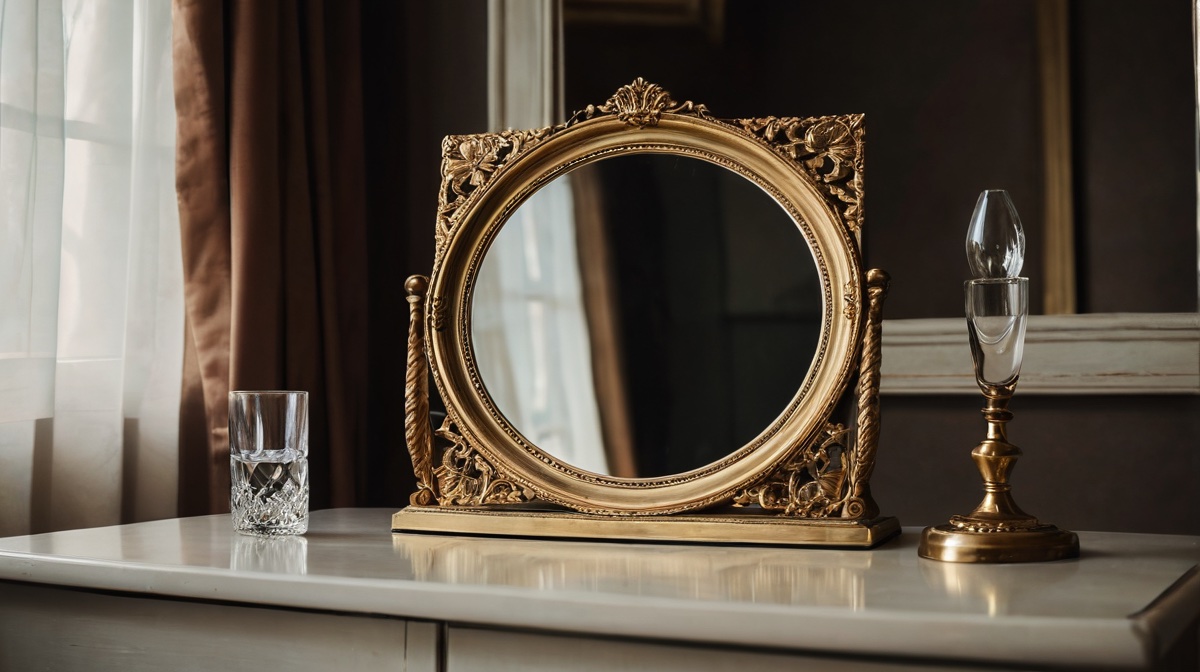
The reading that the vanity tradition cannot accommodate is the one this genre uses most.
She is at the glass with her back to the room. He is behind her, and he believes he is unobserved, because her eyes are pointed away from him. The mirror is angled so that she can see him and he has not worked out that she can. Nothing in the picture is happening, and one person in it has considerably more information than the other.
Formally this is a surveillance device rather than a self-portrait device, and it inverts the whole apparatus of the genre. The usual arrangement gives her authority through height, props and blocking, all of which are visible and all of which he can see too. A mirror gives her something none of that provides, which is an advantage he does not know about.
When the reflection includes the person holding the camera
The last property is the one photographers have to manage rather than exploit. A mirror in a photographic frame reflects the room, and the room contains the lights, the stands, the assistants and the photographer.
Most of the time this is a nuisance and is solved by angling the glass off-axis. When it is left in, the picture changes category. A reflection that shows the camera makes the apparatus part of the subject, and the image stops being a record of a woman and becomes a record of a woman being photographed. The authority claim then has to survive the visible presence of the person constructing it, which most of this material cannot do.
The question of who was standing behind the camera runs through the whole tradition and is taken up directly in women directing and shooting the genre. A mirror is the only device in the vocabulary that can answer it inside the frame, which is presumably why it was so often carefully turned away.
Questions readers ask
Do the reflections in these pictures have to be optically correct?
Almost none of them are, and painting has been cheating in exactly the same way for centuries. A reflection placed where the geometry actually puts it usually shows the wrong thing at the wrong size, so artists move it, enlarge it and change its angle until it shows what the picture needs. Viewers do not check. What they notice is the relationship between the figure and her reflection, and that relationship survives any amount of optical dishonesty.
Is a mirror shot always about vanity?
That is the inherited reading and it is usually the wrong one here. The vanity tradition assumes the woman is looking at herself and finding herself pleasing, which requires her attention to be on her own reflection. In a great deal of this material she is not looking at herself at all. She is using the glass to watch something behind her, which is surveillance rather than self-regard, and the two produce completely different pictures out of nearly identical arrangements.
Reading a sign is half of it
Every motif on this site records something two people agreed to do before anyone drew it. The drawing is the easy part.
See where it happens now