Motif · Posture
The turned back
The short version
A face is the one thing this genre almost never withholds, which is why turning a figure away is its strongest single move. The back also happens to be the easiest surface in the human figure to render and the hardest to make interesting, so the pose rewards good drawing and punishes lazy drawing more sharply than any other. There are three distinct versions, depending on whether the second figure is being faced, and they produce three different pictures. And the arrangement quietly inverts a Romantic convention in which a figure seen from behind is someone the viewer looks with rather than someone who has shut them out.
Almost every convention in this picture language is about delivering a face. The raised chin delivers it at an angle. The low viewpoint delivers it tilted down toward you. The direct look delivers it head on. The whole apparatus is built to make one person’s expression the destination of the composition.
Turning her away removes the destination. The eye enters the picture, travels the usual route, arrives at the head and finds nothing there. That is the entire mechanism, and it is more difficult to sit with than any amount of confrontation.
The one thing the genre never withholds
Consider what remains when the face is gone. Height still reads. Costume still reads. Posture still reads, in some ways more clearly, because a back has no expression to distract from the line of the spine and the set of the shoulders. What stops is the transaction.
An image with a visible face proposes an exchange, even a hostile one. You look, she looks back or pointedly does not, and either way you have been accounted for. A back does not account for you. The figure is not refusing you, which would still be a form of attention. She is arranged with respect to something else entirely, and your position is structurally irrelevant.
The survey in who is standing gives this a paragraph and calls it the strongest of the refusal postures. Working through the printed record, the more precise claim is that it is the only one that removes the viewer from the picture’s logic rather than assigning them a place in it.
A surface, not a shape
There is a practical dimension that explains why the pose recurs even in indifferent work. A back is easy.
The human back is a broad, continuous, roughly symmetrical field with no features to get wrong. There are no hands to fumble, no eyes to misalign, no mouth to make ridiculous. For an illustrator working at speed on cheap stock, as most of the magazine-era hands were, it is the least risky view of a figure available.
The corresponding difficulty is that easy surfaces are boring surfaces. A back with nothing on it is a shape, and a shape holds attention for about a second. So the pose developed a set of standard freights: hair falling across it, a laced corset back, the seam of a long glove, the deep V of a gown, a coat pushed off one shoulder, a chair back cutting across it horizontally. Each of these does the same job, which is to give the largest plain area in the frame a structure the eye can follow.
Photography inherited the problem in a harsher form, because a lit back is a gradient and gradients are exactly what hard studio light destroys. The single-source approach of the studio decades turns a back into two flat regions with a hard edge between them, which is dramatic and almost information-free. Photographers who use this pose well tend to break the light with something: a strap, a strand of hair, a shadow thrown from outside the frame.
Three ways to turn a back
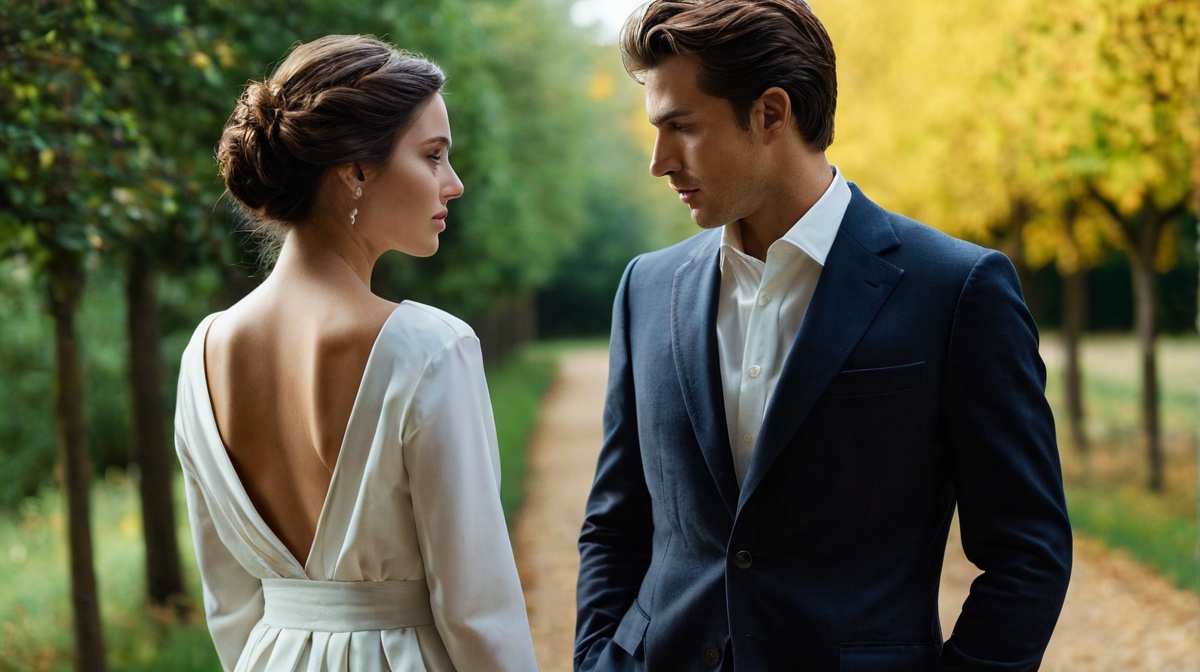
The variants are usually treated as one convention. They are three, and they say different things.
Back to the viewer, facing the second figure. The exchange is happening and you are outside it. This is the most uncomfortable arrangement in the genre, because the picture is clearly about something and it has decided you do not need to see it. The second figure’s face is generally the only one available, which makes his reaction the whole content of the image.
Back to everyone. She faces a window, a door, a wall or nothing identifiable, and neither the viewer nor the other figure is being attended to. Pictures in this arrangement read as an interval rather than an event: the scene is between things. It is rare in the commercial material, because it is difficult to sell an image in which nothing is being directed at anyone, and it is common in the more serious photographic work of the studio decades for exactly the same reason.
Back to the second figure, front to the viewer. This is the aggressive one. She has turned away from the person in the room and toward the person outside it, which makes the viewer the party being addressed and the other figure the one excluded. It converts a scene into a direct approach, a move examined from the other side in looking at the camera.
Looking with her, or locked out

German painting has a name for a figure seen from behind, the Rückenfigur, and it means something close to the opposite of what it means here. In Romantic landscape, most famously in Caspar David Friedrich’s Wanderer above the Sea of Fog, painted around 1818, the figure with his back to us is a stand-in. We are placed behind him so that we can look at what he is looking at, and the back is an invitation to share a view.
This genre uses the same anatomy to lock the viewer out. There is usually nothing to see past her, because the backgrounds are empty by convention and there is no landscape to share. The turned back becomes an obstruction rather than a companion, and the space beyond it is not a view but a place you are not going.
The inversion was almost certainly not deliberate. Illustrators reached for the pose because it was legible, publishable and quick, and the meaning followed from the fact that the genre had already emptied its backgrounds for unrelated reasons of cost. Two conventions collided and produced a third.
The over-the-shoulder return
The version everyone can picture is the compromise: the body turned fully away, the head rotated back over the shoulder, the face returned to the viewer at an angle. It is the most reproduced arrangement in the whole vocabulary and the least interesting, because it takes the refusal back.
What it does keep is the twist. A rotated torso puts a diagonal through a figure that would otherwise be a vertical, the shoulder blade rises, and the line of the neck lengthens. Fashion photography adopted it wholesale, and the tall, torqued figures associated with Helmut Newton rely on it constantly.
It is worth being clear about what the trade is. The full turn is a statement and costs the picture its face. The over-the-shoulder version keeps the face and reduces the statement to a gesture. Both are legitimate. The pictures that are worth returning to are usually the ones that committed.
Questions readers ask
Does a turned back reduce the figure to a body?
It can, and the difference is decided by what else the pose is doing. A back presented squarely, evenly lit, with the head level and nothing else happening, is a display and reads as one. A back that is turned away from someone specific, at an angle, with the head inclined toward a person or object outside the exchange, is a refusal and reads as an act. The same anatomy produces both, which is why this is the pose that separates careful pictures from careless ones.
Why was a turned back easier to publish?
Because obscenity enforcement in the printed decades was largely a matter of listing what could not be shown, and a back appears on very few of those lists. Publishers working under postal inspection learned this quickly and used it, which is one reason the pose is so common in the mid-century material. The censorship advantage was real, but it does not explain the pose, since it survived intact into periods with no such constraint.
Reading a sign is half of it
Every motif on this site records something two people agreed to do before anyone drew it. The drawing is the easy part.
See where it happens now