Motif · Gaze
Looking at the camera
The short version
A figure who looks out of a picture converts it from a scene you observe into an exchange you are part of. That is the whole mechanism, and European painting had already discovered how much trouble it causes long before photography existed. The meaning then reverses depending on where the lens is: the same expression reads as address from below, as assessment at eye level, and as appeal from above. If there is a second figure in the frame who is not being looked at, he has been demoted without anyone moving. The difficult part is telling a genuine address apart from the same look used to sell something.
Most of the conventions on this site are about arranging two people with respect to each other. This one is about a third party, the person outside the picture, and the moment a figure inside it acknowledges that person exists.
It is the most common gaze in the genre and the least examined, largely because it looks like nothing. She is looking at you. There is no pose to describe and no prop involved. What it actually does to the picture is considerable.
Being looked at back
A picture in which nobody looks out is a window. Events happen behind the glass, the viewer is unaccounted for, and the whole arrangement is available for inspection without cost. This is the default condition of most narrative image-making, and it is comfortable.
A returned look closes the window. The figure has registered that she is being observed, and the observation is now a two-way event with a participant on each side. Nothing about the picture has changed except the direction of two eyes, and the viewer’s position has gone from concealed to named.
European painting worked this out on canvas well before anyone had a camera to point. Manet’s Olympia, painted in 1863 and shown at the Paris Salon two years later, produced one of the century’s more spectacular scandals, and the recorded objections were only partly about the body. What critics kept returning to was the look: a figure who was supposed to be an object of contemplation was instead attending to the person in front of the picture, unhurried and entirely unembarrassed. The convention had been that a nude did not notice being looked at. She noticed.
Where the lens is standing
The same look means three different things depending on one variable, and the variable is not in her face at all.
Photographed or drawn from below, the eyes come down to meet the viewer. The head tilts, the chin leads, and the geometry described in who is standing does the rest. This is address in the fullest sense: she has lowered her attention to reach you, and the effort is visible.
At eye level the transaction becomes flat and considerably harder to read. Nobody has adjusted, nothing has been conceded, and the look is simply an exchange between two people at the same height. This is the register of the better studio portraiture, and it is the one that ages best, because it is not doing anything a viewer can dismiss as a device.
From above, the same eyes produce appeal. The viewer is looking down and the figure is looking up, and no amount of costume or prop reliably overrides that. Pictures that mean to make an authority claim and are shot from a stepladder tend to fail, and photographers learn this early.
The man who is no longer being addressed
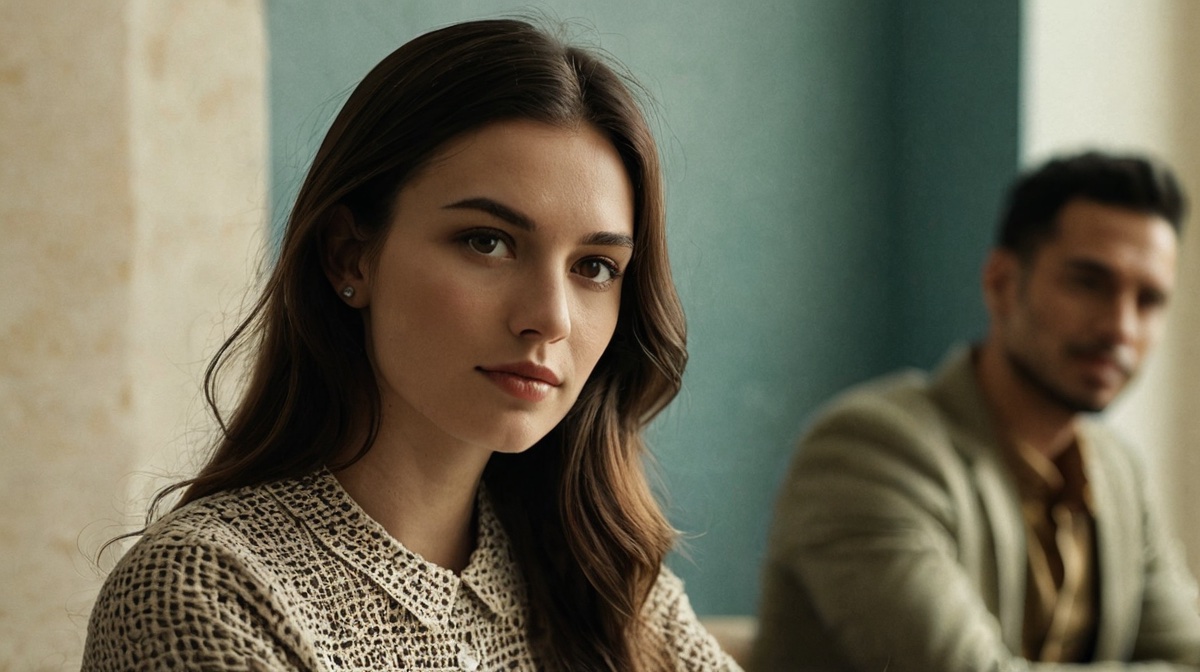
Direct address changes the second figure’s status without requiring him to do anything.
If a picture has two people in it and one of them is looking out of the frame, the other has been passed over in real time. He is in the room, within reach, presumably the reason the scene is happening, and her attention has gone somewhere else. The genre uses this constantly and rarely comments on it, because it is the cheapest way to establish a hierarchy that costs nothing in composition.
The extreme version is the one where he is not in the picture at all and the look implies him. She is looking at the viewer, which means the viewer is standing where he would be, which means the viewer has been assigned his part. The mid-century magazines did this on cover after cover, and it is a large part of why that material sold: the reader was not being shown a transaction, he was being included in one.
The inverse arrangement, where her attention is fully on him and the viewer is ignored, is examined in the averted eye, and it produces a much colder picture.
Why cinema treats it as a rupture
Film has a rule against this and the rule is nearly absolute. Actors are trained not to find the lens, and a glance that lands on it is normally a mistake to be cut. The reason is structural: cinema depends on the audience being unobserved, and a look at the camera cancels that in a frame.
When films break the rule they do it for effect and they pay for it. The interrogation sequence in Basic Instinct is built on a related mechanic without technically breaking it, since Catherine Tramell’s attention is directed at the men in the room and the camera is placed so that the viewer sits among them. The audience gets the sensation of being looked at while the convention stays intact, which is a more careful piece of construction than the film is usually credited with.
Still photography has no such rule. A photographic portrait in which the subject is not looking at the lens is the marked case, and one in which she is is simply a portrait. That asymmetry between the two media is why the printed tradition and the filmed tradition developed such different vocabularies from the same starting material.
Address and solicitation
The hard part of reading these pictures is that direct address is also the native language of selling. Catalogue photography, advertising, magazine covers and mail-order plates all use the same eyes for the same reason, which is to get a stranger to feel spoken to.
Distinguishing the two is genuinely difficult and no single feature settles it. The most reliable tell is whether the rest of the picture is arranged around the viewer or around the figure. A solicitation organises everything toward the front of the frame: the body angles out, the light favours the near side, objects are presented rather than used. An address leaves the scene as it is and simply turns the head, so the viewer is noticed rather than served.
That is a difference of a few degrees of shoulder rotation, and a great many pictures in this tradition sit somewhere in the middle because they were made to be bought. Saying so is not a complaint. It is the condition the material was produced under, and it is why the strongest examples of the direct look tend to come from work that was not for sale.
Questions readers ask
Why is a direct look so much stronger in a still image than in a film?
Duration. In a film a look at the lens lasts a second or two and then the shot changes, so it registers as a rupture and then resolves. In a still image it never ends. The figure is looking at the viewer for as long as the picture is being looked at and for as long as it exists, which is a condition no live encounter can produce. Photographers and illustrators working in this genre understood the permanence as their main advantage over film.
Does a direct look always mean the figure is in control?
No. Direct address is a claim on the viewer, and a claim can be made from any position. Camera height, expression, whether the head is level or tilted, and what the hands are doing all modify it, and a picture can produce a direct look that reads as appeal rather than command using exactly the same eyes. The look opens the channel. Everything else in the frame decides what comes through it.
Reading a sign is half of it
Every motif on this site records something two people agreed to do before anyone drew it. The drawing is the easy part.
See where it happens now