Motif · Gaze
The averted eye
The short version
Looking is a privilege these pictures distribute unequally, and the distribution is the actual subject. There are four places a second figure can put his eyes and each produces a different image out of the same two bodies. The downcast eye is the most common because it is the oldest sign of deference available and costs an illustrator nothing. Removing the eye entirely, with a hood or a blindfold, converts him from a participant into furniture. And the arrangement that works best is a chain of looks in which nobody is looked at back.
The literature on this material spends nearly all of its attention on one person. Where she is standing, what she is wearing, how she is lit, whether she is looking at you. The second figure gets described as present and then dropped.
That is a mistake, because his eyes are doing more compositional work than almost anything she is wearing. In pictures organised around a difference in status, the reliable signal is not who is taller. It is who is allowed to look.
Looking is the thing being distributed
Start from the observation that these compositions are always short of one thing: a way of showing an unequal relationship between two people who are simply standing in a room. Height helps but can be argued with. Props help but can be put down. Costume helps and is only clothing.
Attention cannot be faked and cannot be reassigned by the viewer. If one person in a frame is looking at the other and the other is not returning it, the imbalance is a fact about the picture, not an interpretation of it. Every other device in the vocabulary is a claim; this one is evidence.
Once that is clear, the whole tradition reorganises around it. The raised chin described in who is standing is not primarily about the chin. It is a device for routing her eyeline above his head so that his look cannot be answered. The turned back is the same operation performed with the whole body. Direct address to the viewer sends her attention out of the frame entirely, which leaves him with nothing at all.
Four places a man’s eyes can go
The options are finite and each has a distinct effect.
At her face. Rare, and it changes the genre of the picture. Two people looking at each other are in a scene together, and whatever hierarchy exists has to be established by everything else in the frame. Decadent illustration used this constantly, because the older tradition was about a man consumed by the sight of a woman, and his transfixed stare was the whole content of the image. The pre-war printed material is full of it, and the mid-century magazines largely abandoned it.
At the floor, or at her feet. The standard. It confirms the hierarchy, keeps his face partly hidden, and gives the composition a downward diagonal that reinforces whatever the boot is doing at the bottom of the frame. It also happens to be the easiest expression to draw, since a lowered face requires no eyes at all.
Out of the frame, at nothing. The most interesting and the least used. A second figure staring past everything reads as absent rather than obedient, and the picture becomes ambiguous about whether he is participating at all. It is the only arrangement in the vocabulary that gives him an interior life, and commercially it was almost useless, which is why it survives mainly in work that was not made to be sold.
At the viewer. Almost never, and for good reason. If he looks out of the picture he recruits the viewer as a witness to his own position, and the identification the whole genre depends on collapses. A reader who is being addressed by the man is no longer standing where the man is.
The cost of letting him look
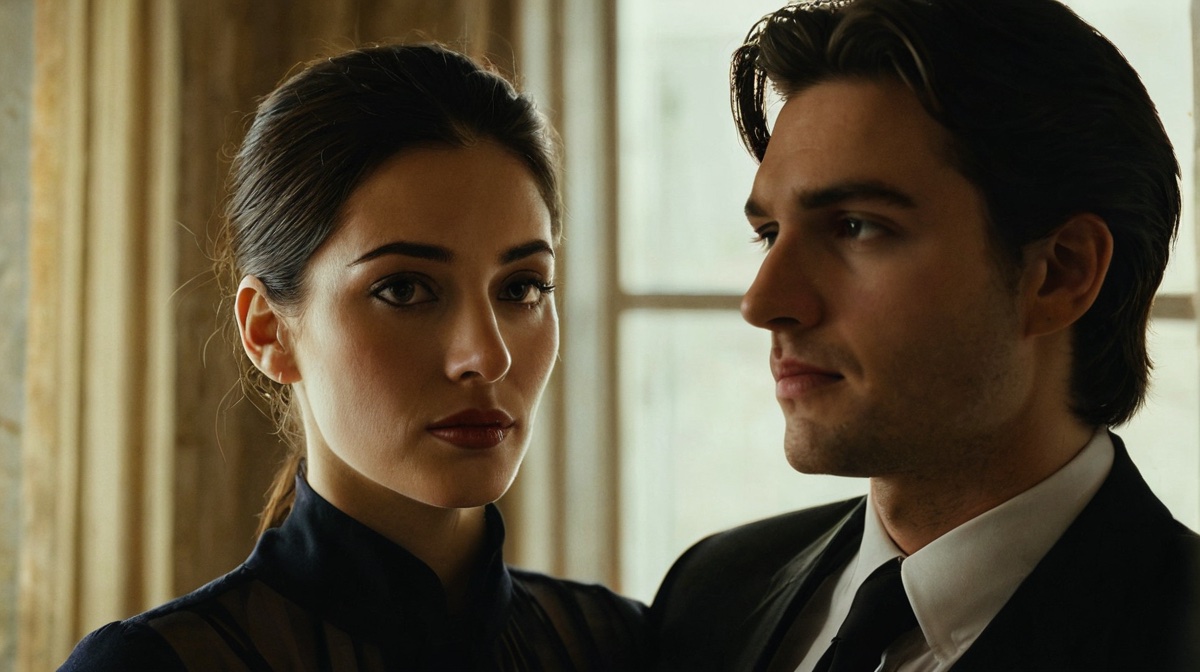
It is worth taking seriously why the transfixed stare fell out of use, because the change tracks a shift in who these pictures were being made for.
In the older tradition his look is the point of the image. She is arranged to be looked at, he demonstrates the correct response, and the viewer is invited to join him in it. The woman is the occasion and the man’s reaction is the content, which means she is functionally an object even when the story insists she is in charge.
Once the picture removes his look, she stops being the occasion for anybody’s reaction and becomes the subject of her own image. The magazine-era illustrators arrived at this without theorising it, and the heavy-line figures associated with Eric Stanton are consistently drawn as people who are doing something rather than as displays being responded to. The reader is still there, still buying it, still positioned somewhere. He is just no longer represented inside the frame by a proxy who is enjoying himself.
Removing the eye altogether
The hood and the blindfold are the terminal case and they are worth separating from the rest of the vocabulary, because they do something the other devices cannot.
A figure who cannot see is not deferring. Deference is an act and requires a choice, and a covered eye removes the possibility of one. What the picture gains is a second figure who can be positioned anywhere without any eyeline consequences at all, which is compositionally convenient and dramatically inert. He becomes a mass in the frame: something to establish scale against, something to put a diagonal through, something for a hand to rest on.
That is a real loss and the better pictures know it. The most common repair is to give him a posture that implies attention without sight, a turned head, a raised chin of his own, a body angled toward a sound. What is being restored is not vision but orientation, and orientation is what the eyeline was providing in the first place.
The unclosed circuit
The arrangement that holds up best across the whole tradition is a chain rather than an exchange.
He looks at her. She looks past him, at something outside the frame, or at the viewer. The viewer looks at both of them and is looked at by nobody, or by only one. No look in the picture is returned by its object, and the whole structure leans in one direction without ever completing.
Cinema calls the completed version shot and reverse shot, and it is the basic unit of screen conversation because a returned look resolves. Still images have no reverse shot, which means they can leave a circuit open indefinitely, and this genre discovered early that an open circuit is the more useful state. Nothing is settled, nobody has been answered, and the picture does not finish.
The drawing room plate on this site was built to test how little of the second figure is needed to keep the chain running. A shoulder and part of a bowed head turned out to be enough, which suggests that what the composition actually requires is not a person but a direction.
Questions readers ask
Why does the second figure so rarely look at her face?
Because a returned look between two people at the same eye level reads as an exchange between equals, which is the one thing these pictures are arranged to prevent. As soon as he is permitted to meet her eyes the hierarchy has to be carried entirely by other means, and most compositions in this tradition are not built to survive that. The pictures that do allow it tend to be the more interesting ones, precisely because they have taken the safety net away.
Is a downcast eye always deference?
Not reliably, and this is where careless reading goes wrong. Eyes lowered toward a specific thing, her boots, her hand, an object she is holding, read as attention and therefore as deference. Eyes lowered toward nothing in particular read as withdrawal, which is a refusal rather than a submission. The difference is a few degrees of angle and whether the head follows, and a lot of otherwise competent pictures get it backwards.
Reading a sign is half of it
Every motif on this site records something two people agreed to do before anyone drew it. The drawing is the easy part.
See where it happens now