Makers · Photography · 1950s to 2004
Helmut Newton: the commanding woman as a fashion assignment
- Person
- Helmut Newton
- Active
- 1950s to 2004
- Known for
- Fashion photography built on tall, self-possessed, commanding women
- Field
- Photography
The short version
Helmut Newton photography took a figure that had been circulating in small-press magazines and put it on the pages of international fashion titles. Born in Berlin in 1920, Newton left Germany in 1938, spent years in Australia, and from the early 1960s built a long career with French Vogue and other magazines. His recurring subject is a tall, composed, unhurried woman who is clearly not waiting for permission. Whether that figure represents an argument for female authority or a highly polished form of objectification has been disputed for fifty years and is not settled.
Helmut Newton spent forty years photographing a woman who is taller than the room, entirely composed, and visibly not waiting to be told anything. He did it for the largest fashion magazines in the world, on commission, and in doing so he moved a figure that had been circulating in cheap small-press publishing into the mainstream of commercial image-making. That relocation is his significance for a site about pictures, and it is separate from the question of whether the pictures are good for anyone, which people have been arguing about since the 1970s.
The record
Newton was born in Berlin in 1920 into a Jewish family and left Germany in 1938. He reached Australia, served in the Australian army during the war, took citizenship, changed his name from Neustädter, and worked as a photographer there before moving to Europe. From the early 1960s he was shooting regularly for French Vogue, which became the platform for most of what he is now known for. He worked steadily until his death in a car crash in Los Angeles in 2004. His wife June, an actress who photographed under the name Alice Springs, was his professional collaborator for decades and administered the work afterwards. A foundation holding the archive operates in Berlin.
The books tracked the magazine work. White Women appeared in the mid-1970s. The large-format nudes he produced in the early 1980s became the best known individual series. Late in life the publisher Taschen issued an enormous single volume of his work that became a talking point in its own right for its physical scale.
The vocabulary
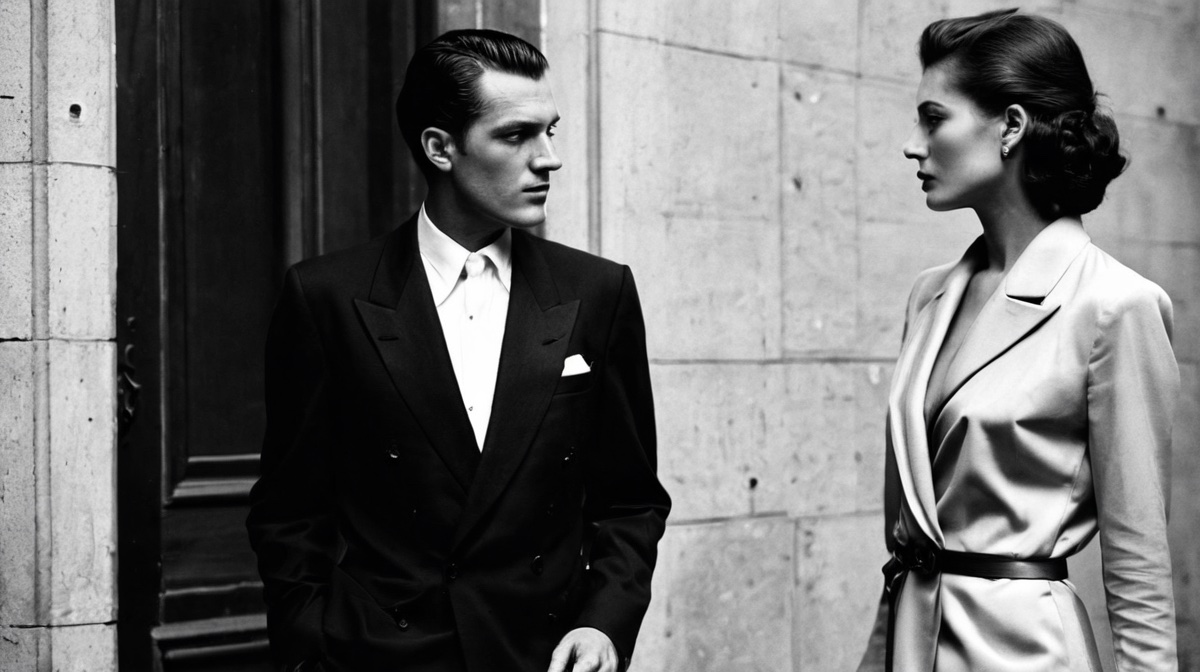
The pictures are built out of a small and consistent kit. Hard flash, often frontal, which flattens skin and makes every surface look slightly wet. Locations that read as expensive and unpopulated: pool decks, hotel corridors, gravel driveways, apartments with too much furniture. Reflections used constantly, so that a viewer is frequently looking at a woman and at her image at the same time. Heels raised high enough to change how a body has to balance, which is a device the the boot page follows back through eighty years of drawing.
The staging is the signature. Bodies are placed rather than caught. Figures stand at the edges of frames looking out of them. Where men appear they are often smaller in the composition, turned away, seated, or engaged in something ridiculous. A recurring device is a diptych: the same group photographed dressed and then undressed in the same positions, which turns clothing into the variable and the posture into the constant. That construction says the authority in the picture was never coming from the outfit.
Height and stance carry almost all of it, which is precisely the grammar that who is standing traces through the printed tradition, and which was fully formed in cheap magazines a decade before Newton’s first Vogue commission. He was not borrowing from those magazines so much as arriving independently at the same solution to the same problem.
The argument that never closed
The disagreement about this work is genuine and it has good people on both sides.
The case for the work runs like this. Newton’s women are not passive, not damaged and not apologising. They occupy the frame, they look back or refuse to, and in a commercial genre that spent the century posing women as decoration, that is a real distinction. Several of the models he worked with have said publicly that they found the sessions collaborative and the results flattering to their own sense of themselves.
The case against runs like this. These are advertisements. Whatever a picture appears to say about a woman’s authority, it was made to sell clothes, and the arrangement of her body was determined by a man holding the camera for a client. The recurrence of restraint, injury and prosthesis as fashion motifs in some of the series is read by critics as aestheticising harm rather than commenting on it. The writer Susan Sontag challenged him directly about misogyny during a French television appearance, and that exchange is still cited by both camps as evidence for their side.
Newton’s own answers to the charge were consistent and mostly unhelpful, which is fair enough: an artist is not obliged to supply the reading. What can be said without picking a side is that the ambiguity is structural. A photograph can show a woman in command and be commissioned by someone who profits from looking at her, and both facts are true at once.
That double condition is not new. It defines almost everything covered in from postcards to print, and it runs through the illustrated work of Eric Stanton a generation earlier, where the towering woman on the page was drawn to order for a paying subscriber.
Questions readers ask
Did Helmut Newton invent this kind of image?
No, and he never claimed to. Commanding women had been standard material in the postcard trade and in mid-century small-press magazines for decades before he photographed one. What Newton changed was the address. He put the figure into the highest-circulation fashion magazines in the world, printed on good paper with a couture budget behind it, which moved her out of a subculture and into the mainstream visual language of fashion.
Why is the work still argued about?
Because the images support two honest readings. In one, the women are the only people in the frame with any authority, they are rarely shown as victims, and the men are frequently peripheral or absurd. In the other, the pictures were commissioned by magazines, shot for a commercial client, and arrange women for a viewer whose position the photographer controls entirely. Both descriptions match what is on the page.
How much of a Newton photograph is location and how much is studio?
Both, and the distinction is less useful than it sounds, because the location work is staged as thoroughly as anything built on a set. Hotel corridors, swimming pools, driveways and apartment interiors recur, lit hard so that they read as constructed rather than found. A Newton exterior is not a snapshot of a place. It is a set that happens to be real, which is part of why the pictures feel arranged even when nothing in them is obviously artificial.
The picture was a job before it was a style
Everyone on this page was working from a brief, and the brief came from what an audience kept asking for. The asking has not stopped.
See where it happens now