Motif · Setting
The street
The short version
Taking the figure outdoors changes the audience for the arrangement. An interior scene is private and answerable to nobody; a street scene is public, which means it either contains witnesses or has conspicuously removed them, and either choice is content. The street also supplies scale, which the empty backgrounds of the printed tradition never had, so the figure can finally be measured against something. Wet road surfaces take over the reflective job that polished studio floors were doing. And an emptied street at night has been built rather than found, which makes it a stage.
For most of its printed history this figure lived indoors. Rooms were cheap to draw, controllable to light, and legally safer to work in, and the result is that the whole vocabulary developed inside four walls that were usually not even shown.
Moving her onto a pavement changes more than the backdrop. It introduces a public, and a public changes what a private arrangement means.
What a witness does to the arrangement
Indoors, a scene between two people answers to nobody. The room is sealed, nothing outside it is implied, and whatever the two figures have agreed is entirely their business. That sealing is a large part of why the empty background became a convention rather than just a saving.
A street has traffic, windows, doorways and the permanent possibility of somebody walking into the frame. Every one of those is a potential witness, and the composition has to take a position on them. It can include them, in which case the picture becomes an account of something seen. It can exclude them, in which case the exclusion is visible and the emptiness becomes a deliberate act.
The choice is worth watching because it determines who is being addressed. A pavement scene with a passer-by has already assigned the role of observer to somebody inside the picture, and the actual viewer is demoted to a second-hand position. Empty the street and the viewer is the only one there, which is a considerably more exposed place to stand.
Something to be measured against
The single largest gain is scale. The printed tradition made its claims about height with no reference points at all: an empty ground, an implied floor line, and two figures whose relative size the artist could set to anything. The claim worked, but it was unfalsifiable, and part of why the mid-century plates read as fantastical is that nothing in them can be checked.
A street is full of things of known size. A kerb is a kerb. A car door comes to a particular height. A doorway, a railing, a lamp standard, a paving slab, a shop front, all of them carry dimensions the viewer already knows. Put a figure among them and the height becomes measurable, which means it becomes real.
The effect on the pictures is immediate. Outdoor work in this genre tends to abandon the extreme low viewpoint, because it no longer needs to manufacture stature and because a low angle among buildings distorts the architecture in ways the eye catches at once. What replaces it is a level camera at a distance, letting the figure be tall against something rather than tall because of where the lens was put. The same adjustment, made for the same reason, is described in the note to the studio floor plate.
Wet tarmac, and the floor problem again
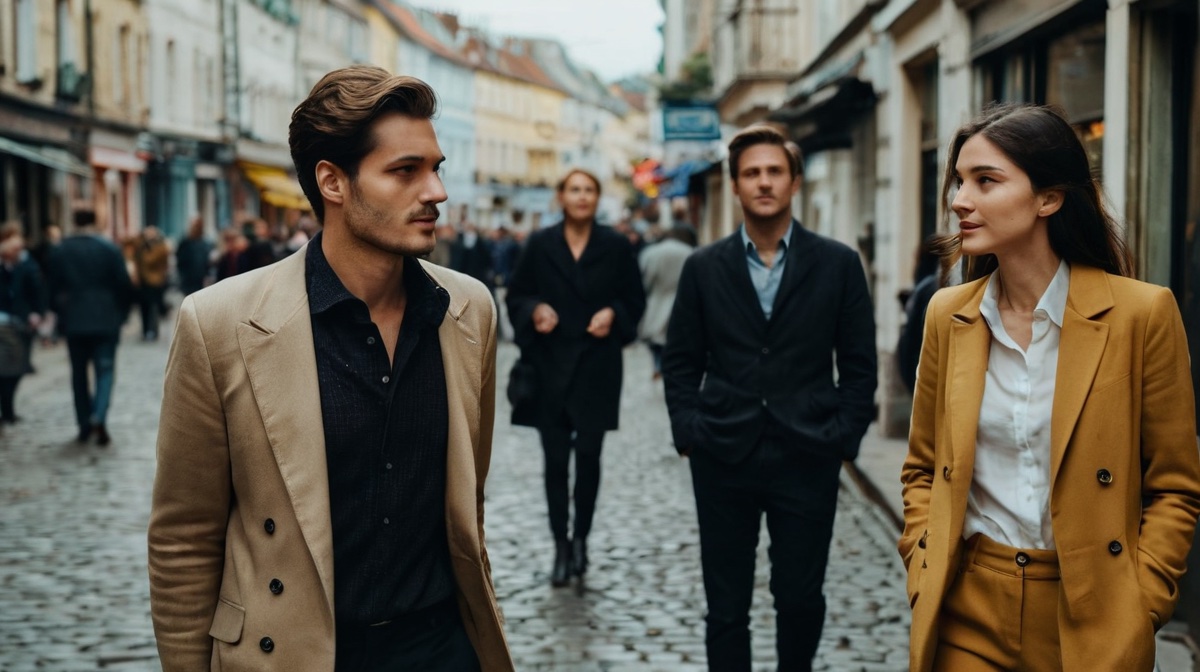
The reflective surface is one of the genre’s oldest dependencies, and outdoors it is supplied by the weather.
A dry road is a matte grey field that absorbs light and gives nothing back. A wet one is a mirror with a texture: it doubles every light source, stretches highlights into vertical streaks, and fills the lower third of the frame with information nobody had to arrange. That is precisely the job the polished floor was doing indoors, and it arrives outdoors at no cost beyond patience.
Crime cinema worked this out early and wrung it dry. The wet night street is so bound up with the low-key style described in the femme fatale in film noir that it now reads as a quotation of that cycle whatever the intention. Still photographers inherited both the technique and the association, and the more interesting ones have tended to shoot wet streets in daylight specifically to get the surface without the reference.
The empty street is a set
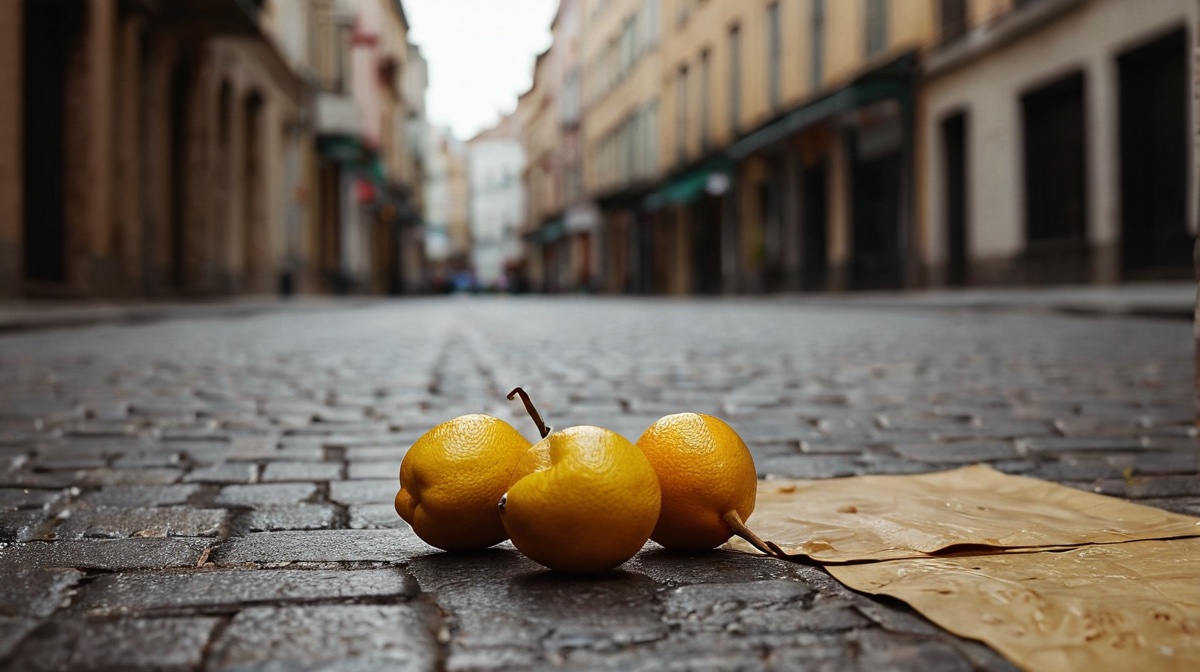
It is worth being blunt about the artifice. A city street with no people in it does not occur. Somebody cleared it, or it was photographed at an hour chosen because nobody would be there, or the frame was composed to exclude everyone who was.
That artificiality is the setting’s real subject in most of the strong work. An emptied street is architecture without its purpose: pavements nobody walks on, crossings nobody uses, lit windows behind which nothing is happening. Put one figure into that and the setting stops being a city and becomes a stage the size of one, and the scale gain described above turns into something stranger than realism.
Night makes it easier and more extreme. Darkness removes everything the lights do not reach, so the photographer selects the set by choosing where to stand. The figures in this kind of work are typically small in the frame, which is the opposite of everything the printed tradition did, and the authority reads anyway because the whole visible world has been arranged around one person.
The car, which is an interior you can park outdoors
The last variant is worth naming because it solves a contradiction. A car is a private room with windows, and it can be put in the middle of a public street.
Everything the interior tradition depends on is available inside it: enclosure, controlled light, a seated figure, a fixed distance between two people, a door that somebody controls. Everything the street offers is available around it: scale, witnesses, weather, reflections. A figure seated behind a windscreen at night is simultaneously in the most private and the most public setting the genre has, and the glass adds a reflection of the street across her face at no charge.
It is also the only setting in the vocabulary where the seated figure, examined in the throne pose, is also the one in control of the movement. That combination does not exist anywhere else, and it is the main reason the car survived into contemporary work while most of the other outdoor arrangements settled into cliché.
Questions readers ask
Why did the figure move outdoors at all?
Mostly because the interiors had been exhausted. By the time the studio decades arrived, the empty room with one hard light had been photographed thousands of times and had very little left to yield. Fashion photography had already made the move for its own reasons, discovering that a street supplies architecture, weather, incident and scale for free, and the material discussed on this site followed it out of the studio for the same practical reasons.
Does a passer-by in the frame weaken the picture?
It changes what the picture is about rather than weakening it. With a bystander present the image becomes a scene that has been observed, and the bystander stands in for the viewer, which usually reduces the direct address to the person looking. With the street emptied, the viewer is the only witness available and the address becomes personal. Both are usable. What does not work is an accidental bystander, because an unintended witness reads as an error and pulls the eye straight out of the composition.
Reading a sign is half of it
Every motif on this site records something two people agreed to do before anyone drew it. The drawing is the easy part.
See where it happens now