Screen · Documentary · 2012
Bettie Page Reveals All: a film about a woman who would not be photographed
- Work
- Bettie Page Reveals All
- Director
- Mark Mori
- Year
- 2012
- Kind
- Documentary
The short version
Bettie Page Reveals All, directed by Mark Mori, premiered at a festival in September 2012 and reached American cinemas through Music Box Films in November 2013. Page narrates the entire film herself, in audio only, cut from interviews Mori recorded with her in 1996 and 1999. She appears nowhere on camera, because from the late 1950s she refused to be photographed and never changed her mind. The result is a film about the most reproduced figure in mid-century pin-up and bondage photography that is made entirely from photographs that other people took of her, with her voice running over the top of them.
Every picture on this site is a made object with somebody behind it. The unusual thing about Bettie Page Reveals All, directed by Mark Mori and released to American cinemas in November 2013 after a festival premiere the previous September, is that the subject of the film had spent fifty years declining to let anyone add to the pile.
She narrates it anyway. The whole film is carried by her voice, and there is not a single new image of her in it.
A voice recorded for a different purpose
Mori has described how the audio came about. He interviewed Page twice, in 1996 and again in 1999, and ended up with somewhere around five or six hours of recording. His stated intention at the time was to get her account on the record, not to build a narration track. Using it that way was a later decision.
That origin is audible and it works in the film’s favour. The delivery is unhurried and conversational, with the flat Southern cadence reviewers kept remarking on, and it is plainly not a performance for a camera. She is answering questions somebody asked her, at length, in her seventies, about events forty years earlier. What arrives on the soundtrack is testimony that happens to have been repurposed, which is a very different register from a subject narrating her own documentary.
It also puts her in a position that none of the still photography ever gave her, which is the position of the person supplying the account rather than the person being accounted for. The pictures in the film were made by other people. The words are hers, and they occasionally disagree with the pictures.
The refusal that structures the film
From the late 1950s onward Page would not be photographed. The reason she gave was straightforward: she wanted to be remembered as she had looked then. She held to it for the rest of her life, and Mori has said he went in expecting to change her mind and failed.
For a film this is a serious problem and Mori turns it into the subject. The visual track has to be assembled entirely from the existing archive, which means every image the viewer sees was made during a working period of roughly a decade, by photographers and studios who were paying her. There is no later footage to cut to, no present-day interview to anchor it, and no way for the film to show the woman who is speaking.
The effect is that the archive starts to look like what it is. Thousands of frames of one person, produced commercially, circulating for half a century without her, while the person herself has removed her image from the market entirely. A documentary that could show her aged would have closed that gap. This one cannot, and it is far more interesting for it.
Klaw, the subpoena and the destroyed negatives
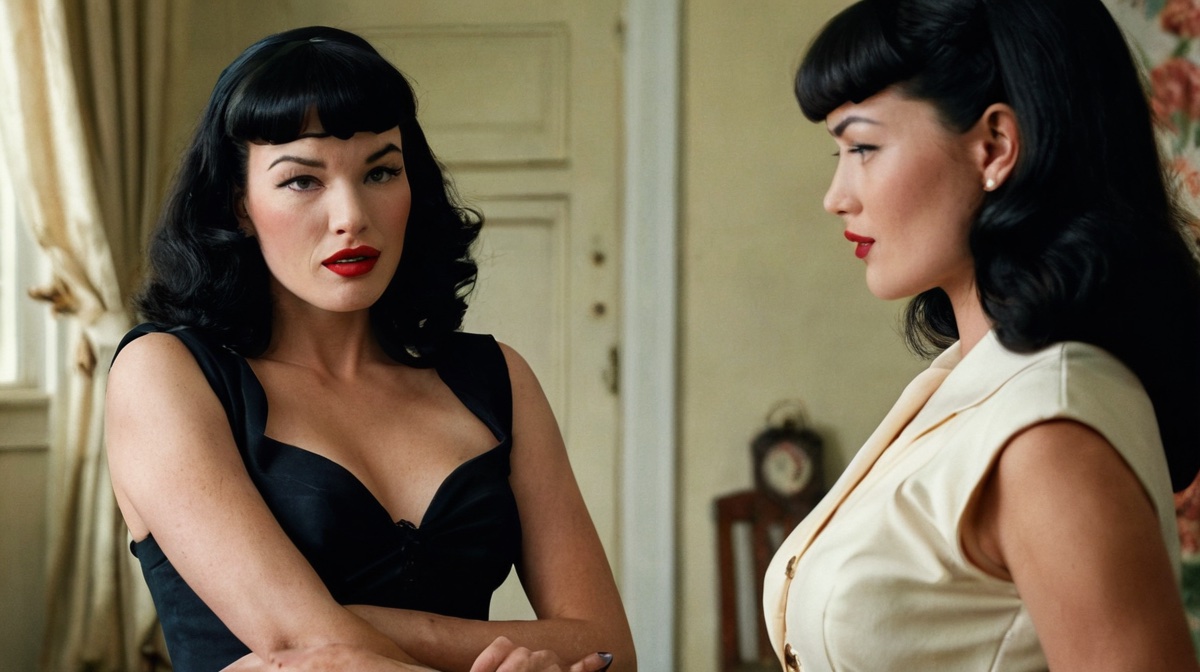
The film goes through the mail-order period, and the facts of it are on the public record independently. Irving Klaw ran the New York operation that produced and sold the bondage photographs and illustrated serials, the same business that supplied the pages discussed in the profile of Eric Stanton.
In 1955 the Senate subcommittee investigating juvenile delinquency, chaired by Estes Kefauver, turned its attention to that trade. Klaw was subpoenaed in May of that year and invoked the Fifth Amendment. Page was summoned and never called. Klaw was later required to destroy quantities of negatives, and his business partner Paula Klaw preserved some of the material anyway, which is a substantial part of the reason an archive exists at all. Page’s last studio session for the operation was in 1957.
Mori obtained and restored nine of the short dance films Klaw sold, and the film uses them. Paula Klaw is credited among the voices, though she died more than a decade before release, so what appears is archival: a recorded telephone conversation between the two women, of which the film uses a small part.
Who took the pictures
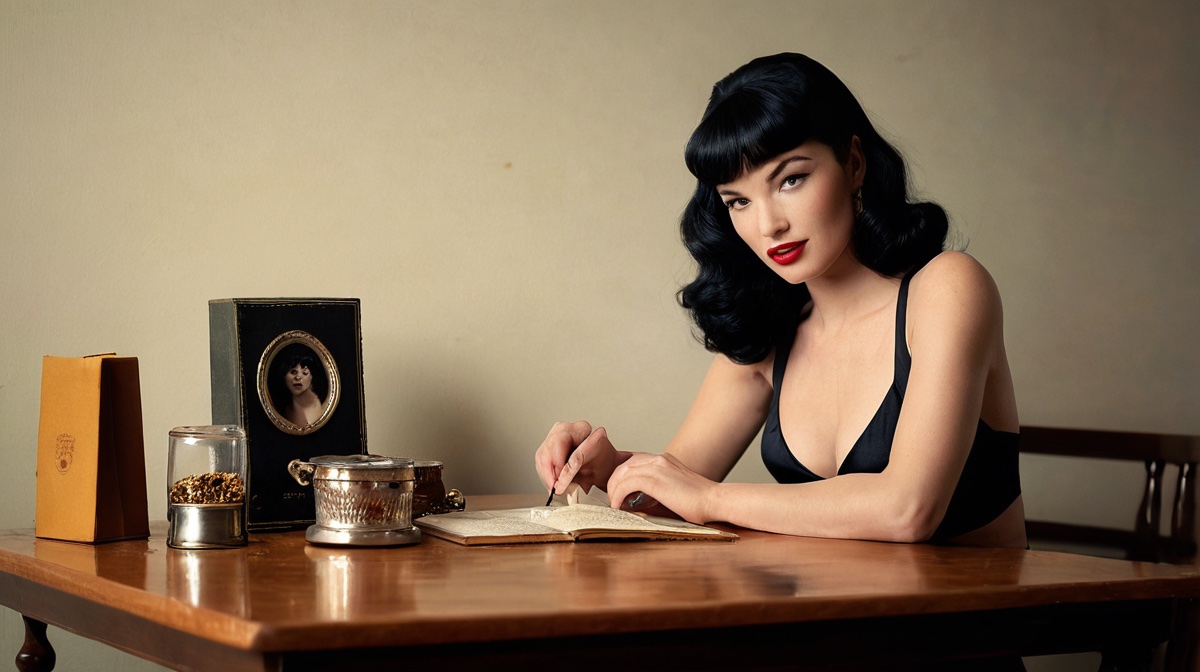
Among the people interviewed are Hugh Hefner, Dita Von Teese, Tempest Storm, Mamie Van Doren, Rebecca Romijn and the photographer Bunny Yeager, whose Florida sessions produced some of the best known colour images of Page.
Yeager is the one that matters most for the argument this site keeps returning to. She was a working photographer who had modelled herself, and she shot Page for a market that was almost entirely male-run. Her presence in the credits is a rare instance of the question raised in women directing and shooting the genre having a documented answer, in a field where the crediting conventions usually erased it.
Hefner’s presence pulls in the other direction and the film knows it. He is there as a publisher whose magazine reproduced her, which places him among the people who benefited from the archive rather than among the people who made it.
What the film does not settle
The unresolved question is the one every account of Page runs into, which is how much of it she was directing. Contemporary writing tends to treat her as the author of her own poses, cheerful and in control. Set against that is the commercial structure she was working inside and the small sums involved.
The film does not resolve this and does not try to. Her voice gives an account, other people give theirs, and they do not always line up. Critical reception was broadly favourable and the recurring complaint was conventional construction rather than dishonesty.
What it does establish, by the sheer weight of the material it has to work with, is how completely the printed trade of the period turned one person into a supply of images. That process is the subject of the magazine era at the level of the presses and the postal system. Here it is visible at the level of a single face, repeated for a hundred minutes, with the woman it belonged to talking over the top of it and refusing to appear.
Questions readers ask
Why is there no footage of Bettie Page in a film about Bettie Page?
Because she stopped allowing photographs of herself after the late 1950s and kept to that for the rest of her life, preferring to be remembered as she had appeared at the time. Mori has said on the record that he expected to talk her round and did not manage it. The audio he recorded in 1996 and 1999 was gathered to get her account down rather than as narration, and the decision to build the film on it came later.
Did Bettie Page testify before the Kefauver committee?
No, and the claim circulates widely enough to be worth correcting. The Senate subcommittee investigating juvenile delinquency, chaired by Estes Kefauver, examined the mail-order trade in 1955. Irving Klaw was subpoenaed that May and invoked the Fifth Amendment. Page was summoned, waited, and was never called to the stand.
The lens was pointed by somebody
A film can only record an arrangement that a group of people worked out first, usually on paper, usually in a room. That part never appears in the credits.
See where it happens now